Background
America is celebrating its 250th birthday this year. Or is it our anniversary? Officially it is our semiquincentennial. Quite a mouthful. I must admit, it does not roll off my tongue, nor does its less used alternative sester centennial. When tempted to show off a bit and actually use semi quincentennial in a sentence, I am forced into a state of mental gymnastics. I must first load in 200 years Associated with the *Bicentennial. Much easier to remember. Then add quin. Then hope it comes out correctly after a 5 second delay in spitting it out. Why bother? It’s nearly over anyway. I’m going with America250. Then again Quarter Millennium has a certain gravitas.
Our nation’s 250th also coincides with another important anniversary of sorts, taking place roughly this year or approximately this decade, give or take. CAPITALISM, or modern capitalism to be more precise. Modern capitalism and democracy have coexisted for about the same amount of time. Coincidence? More likely you can’t have one without the other.
Capitalism developed gradually over time. Its roots dating back to the Middle Ages. The free-market system we have today was made possible by the creation of institutions that enable capitalism to work. Like the private ownership of land and businesses, trade networks, banking, joint stock companies, and the like. By the late 1700’s through the 19
th century, the Industrial Revolution, propelled by capitalism and vice versa, helped build the most powerful nation the world has ever known. Democracy meets capitalism. And, Bob’s your uncle.
Two of the main components and central to capitalism, is production and consumption. Someone invents, copies or steals something they believe, meets a need, solves a problem, makes life easier, or at the very least they think they can convince the consumer to buy it. This could be a product, service, or possibly both. Ideally that product or service would be of good quality, well designed, and offered at a fair or reasonable price. The purchaser of said product or service, would pay the seller either in cash, by check (good luck), credit card, and now through a variety of electronic payment methods such as Apple Pay or Venmo, perhaps crypto. The purchaser in some way takes possession and uses it as directed. Assuming the product works, is not defective and the purchaser is content, that’s usually the end of the story.
This is essentially how the marketplace worked up until the
Digital Information Revolution, when software entered the arena. An astounding amount of data, information, programming and more all on one disk, thumb drive or download. They now how our world works. Much of it taking place in the “cloud”. Somewhere out there in the heavens it seems but in reality, among server farms or data centers around the world. This has created an opening, an opportunity for inventors, producers, and marketers to dramatically increase the cost of their product or service. How?
Enter
digital subscription services, which I now confess is ubiquitous. A simple yet ingenious method that enables you to part with your money in a thoughtful new way. Your initial cost is very low, seemingly very affordable, even cheap. You then pay a monthly fee, or perhaps an annual one, taking advantage of a small discount. For how long? Well forever if you need or want to use any of the programs essential to your existence. If you’re lucky, the seller may offer a lifetime price, often 3-5x the annual fee up front.
At the end of the day, you will most likely end up paying many times more than the original price of any of these products or services. Usually exponentially higher. You never really own the product you’re purchasing. You rent it. Here’s a case in point-
I purchased the Adobe CS6 Design Suite in 2012 for $650. It is a software bundle of products including Photoshop, Dreamweaver, Adobe Illustrator, among others. It is an essential tool for web design, photo editing, and other creative endeavors. I use it often and thank my lucky stars it works and works well. It has also not been rendered useless or redundant or in other ways degraded by product fixes or updates. Less than one year after purchasing, CS6 Adobe stopped selling boxed physical discs (Cds/Dvds) and the accompanying perpetual licenses in favor of the Adobe Creative Cloud. You can now only rent Photoshop and all other products Adobe offers. CLICK ON
ADOBE SUITE CS6 for a breakdown of my costs.
I ran the numbers and discovered that had I not purchased Adobe CS6 when I did, and relied upon the Creative Cloud services for these products, I would have paid out a whopping
$35,095.20 plus tax. 54x more than what I paid to buy and own it 14 years ago. An over 5000% increase. Why that’s just nuts! There are numerous other examples. You no doubt have several subscription services you are paying for over and above the acceptable ones like electricity or car payments. Software related subscription like: Microsoft 365, QuickBooks, Dropbox and ChatGPT.
Listening to Music- New Options
Let’s look at something closer to home- Music Streaming. Growing up we called it our “record collection”. LP’s and 45’s. Followed later by tapes (4 and 8 tracks), CDs and several ways to play them including the record player. I can hear your kids or grand-kids chuckling while you attempt to explain the Sony Walkman, DVD player, reel to reel or, God forbid, the 8 tracks you listened to as a teen.
In our youth we walked into a record store, browsed the albums, discovered something new, brought it home, removed the cellophane, examined the artwork, read the liner notes, and placed the record on the turntable. Over time, our records became more than a collection of music. They became something of a personal history. A particular album might remind you of a summer, an old girlfriend, a concert, your first apartment or the friends with whom you listened to it. Not only did we own the music but the physical objects associated with all our experiences and memories as well. Part of our autobiography if you will.
Today, whether it’s Apple or Amazon Music, YouTube or my favorite, Spotify, we no longer own any of the music we listen to. Consequently, over the years we have given away, sold or lost our records, record players and most of the other devices we used to play our music. We now rely on our Sonos speakers, our phones and the car radio. Spotify gives us access to vastly more music than we could ever have afforded to purchase. But our Spotify library isn’t quite the same thing as the records we spent years collecting. Stop paying and you stop listening. Remember that part?
The same applies to movies. I still have over 400 full length feature movies I purchased over the years, but only an old laptop with a DVD player to play them. The Sony Disc Player that held and played my movies stopped working several years ago as did my PS3 (PlayStation 3) from 2006. Too bad because it also played the then new Blu-ray Discs. I have about a dozen of those.
But TJ, consider the up side:
freedom from possessions. Wasn’t the 60’s partly about that? There is something liberating about not owning things. What would Buddha say? I am sure he, along with millions of yoga enthusiasts and meditators would agree. I do like the concept behind the Sand Mandalas created by Tibetan Monks. Using a small, ridged metal funnel called a
chak-pur, the monks meticulously drop millions of individual grains of colored sand to build a complex, geometric map. This map represents the cosmic universe or the celestial palace of a specific Buddhist deity. The process requires intense meditation, patience, and can take anywhere from several days to multiple weeks to complete. The exact moment the final grain of sand is laid, the entire structure is swept away (dismantled/destroyed) in a highly structured dissolution ceremony. Just like that it’s gone. There is a beauty to this lesson on
impermanence.
Imagine moving across the country without having to pack hundreds of records, books, CDs or DVDs. You can access much of the same entertainment on a device that fits in your pocket. You don’t need shelves, storage space, insurance or maintenance. You aren’t accumulating things that will eventually become someone else’s responsibility. And you aren’t burdened by the feeling that you must preserve everything you’ve ever acquired. It’s also way better for the environment. Perhaps, but I am convinced that the permanent sound of crickets in my ears is from the bagillions of microwaves connecting all our devices traveling through the air, and not tinnitus.
Then again, I could own 500 records, enjoy them immensely, and still accept that they will eventually pass out of my life. Or, conversely, I could own almost nothing but be deeply
attached to my Spotify playlists, my subscriptions, my access to entertainment and my expectation that these services will always be available. Trading the responsibilities of ownership for the obligations of continued access. The absence of possessions does not necessarily mean the absence of attachment.
Yikes. So, Grasshopper, the bottom line I suppose is that humans need some kind of attachments, even if it’s only our digital playlists, painstakingly curated and boundless.
The bigger problem for me isn’t that subscription services exist. It’s that subscriptions are increasingly the
only way to obtain something that we once had the option of owning outright. Whether we will someday not be free to choose between them.
The repercussions are fundamental, and could represent a significant change in the relationship between capitalism, consumers, manufacturers, and society itself. We are moving from a society in which we pay to own things to one in which we must
continually pay for permission to use them. This newer model seeks to make the customer a continuing source of income, even after the original transaction has been completed.
Gotta give it to these
cutting-edge capitalists. Their ingenuity is impressive. Separating the product from the things it can do in our minds was a stroke of genius. Some consumers will rebel but the precedents have been set. Squeezing profits from places no one dreamed possible just a few decades ago. Do we need legislation to protect us from ourselves? Good luck with that.
Many consumers are spending more than they realize on recurring fees. Subscription spending for the average American is about $219 a month, totaling over $2,600 a year. Not surprising, entertainment and retail services make up roughly 43% of these recurring monthly payments. Think Netflix, Amazon Prime, Apple TV and Xfinity to name a few. Gen Z has the fastest-growing subscription spending (up nearly 14%), while Gen X remains the highest overall spender.
Good to know, Baby
Boomers handle subscriptions much differently than their younger counterparts, acting as the most cautious and stable segment in the subscription economy. Boomers are keeping their tabs strictly managed.
Subscription Creep
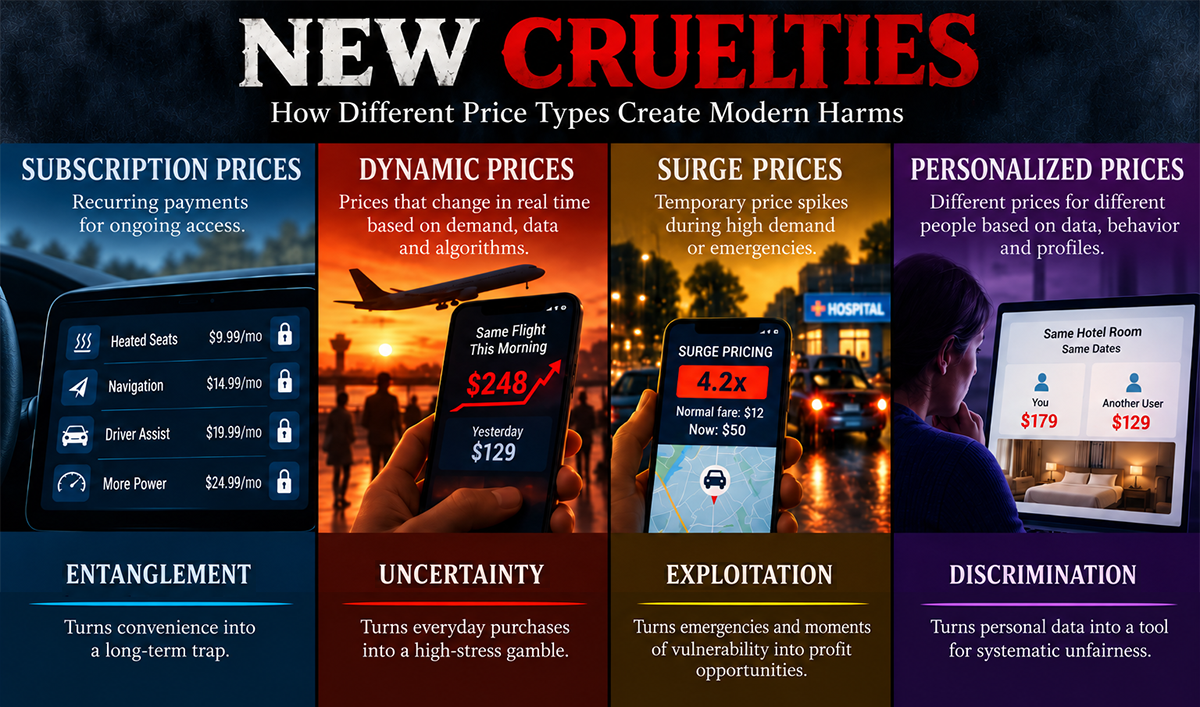
The concept behind subscription services is breaking out into the wider consumer arena. Take the Automotive Industry for example. Car manufacturers have experimented with charging recurring fees for connected features like driver-assistance functions, performance upgrades, or even features physically built into the vehicle. Things like Cloud navigation, live traffic and destination assistance. That is different from let’s say HP Instant Ink or a satellite service like Star Link, where the company is continuously providing ink or a communications infrastructure.
In 2022, BMW introduced a “functions-on-demand” subscription program in select international markets (such as the UK, Germany, and South Korea) that charged roughly $18 a month to activate pre-installed heated front seats. Consumers widely criticized this action, feeling they were forced to pay twice for hardware already built into the vehicle. BMW officially dropped the heated seat subscription service in 2022. While BMW took the brunt of the “heated seat” PR disaster, several other major automakers have successfully paywalled or tested subscriptions for physical hardware built into their cars:
POPUP–
| Manufacturer |
What They Charged For |
Cost |
Status |
| Toyota |
Key Fob Remote Start: Charging to use the physical button on the key fob to start the car remotely. |
$8/month or $80/year |
Active |
| Mercedes-Benz |
Acceleration Increase: Software unlocking a physical horsepower and acceleration boost on electric models. |
$1,200/year |
Active |
| Mercedes-Benz |
Rear-Wheel Steering: Unlocking a sharper turning radius hardware capability on the EQS luxury EV. |
$576/year |
Active |
| Tesla |
Full Self-Driving (FSD) & Range: Pay walling advanced driving capabilities or limiting battery capacity through software. |
$99–$199/month |
Active |
| Audi |
Functions on Demand: Software-locking physical matrix LED headlights or dual-zone climate control settings. |
Varies by feature |
Active |
I am sure this is only the beginning. Every industry is no doubt watching and waiting for their chance to jump in.
It raises the question: “
If I paid for the hardware, why should I have to keep paying to use something already built into it?” Good question. My response- A resounding NO you should not. Alas, we are swiftly becoming a nation of renters. Transitioning from ownership to perpetual dependence while providing our suppliers a permanent, continuous revenue stream.
I could have left well enough alone and signed off right now. But I thought you would want to know what the other candidates were for New Cruelties that I mentioned at the very beginning. So, here they are:
Personalized Pricing– (aka surveillance pricing) is a business strategy, and actual practice, where companies use artificial intelligence and individual consumer data to charge different people different prices for the exact same product or service. Personalized pricing relies on a continuous loop of data collection, algorithmic prediction, and real-time adjustment. Retailers and digital platforms gather vast amounts of information about you as you browse. This includes your browsing history and search patterns, your location possibly determining your income level, your device and operating system- whether you’re shopping on an expensive smart phone or an old computer, past purchase history including loyalty program data and your “level of urgency” (I need a new furnace today”) for any purchase. It is all poured into the hopper and an algorithmic prediction is made. How much is this sucker willing to pay? Discounts are offered on the spot if it is determined you might not be able to afford the current price. In theory Personalized Pricing could result in a more equitable arrangement for consumers; lower prices for those less able to pay, higher for those with deep pockets resulting in a fair profit for sellers. Something tells me that these high-minded ideas are not behind this push. More like “How much can we get
this person to pay?”
There’s no reason this model can’t be incorporated into subscription services. Perhaps it is already. Trapping you into a higher monthly fee right from the get go, than the guy down the street. I wouldn’t be surprised if the airlines and the medical industry were early adapters of this practice. Speaking of airlines. I clearly recall sitting on an airplane sometime in the 80’s waiting for takeoff. For some reason I started to wonder what others on my flight were being charged for coach seats. Why not start a conversation by asking aloud how much each person paid for their ticket. My assumption was there was a wide discrepancy. I remained silent and avoided a mini-riot.
My final candidate for civilization-ending pricing is more a projection than a current reality. But given what we have experienced already, perhaps not that farfetched. Let’s call it “
Mandatory Access Pricing.” Other candidates include: “Perpetual Purchase Pricing,” “Necessities-as-a-Service,” or, “Renting Your Daily Life.”
Suppose the entire food and beverage industry colluded to offer their products to the consumer (for home use) on a subscription basis for home delivery only. The most dystopian version would combine several pricing schemes at once:
Plan A- You don’t buy necessities anymore. You subscribe to a monthly household plan. The company decides how much you receive, when you receive it, unused allotments expire, extra use costs more, cancellation carries a penalty, and your price is adjusted according to what the company believes you can afford.
Plan B- You can purchase your necessities. Bread, milk etc. will be delivered to you with the following caveats:
- The company knows your income and charges you more because its algorithm concludes you can afford it.
- You pay $500 a month for food credits, but unused credits disappear at the end of the month.
- Milk normally costs $4, but during a snowstorm it becomes $9 because demand is high.
- Basic bread is included, but whole-grain bread requires the “Premium Nutrition Plan.”
- Bundling: You can’t subscribe just to milk. To get milk you must also pay for eggs, bread, cereal and bottled water.
- Standard delivery comes sometime during a three-day window; another monthly fee gets you a guaranteed delivery day.
Alright, fun times over. Back to more serious issues. Don’t forget to vote.
TJ