

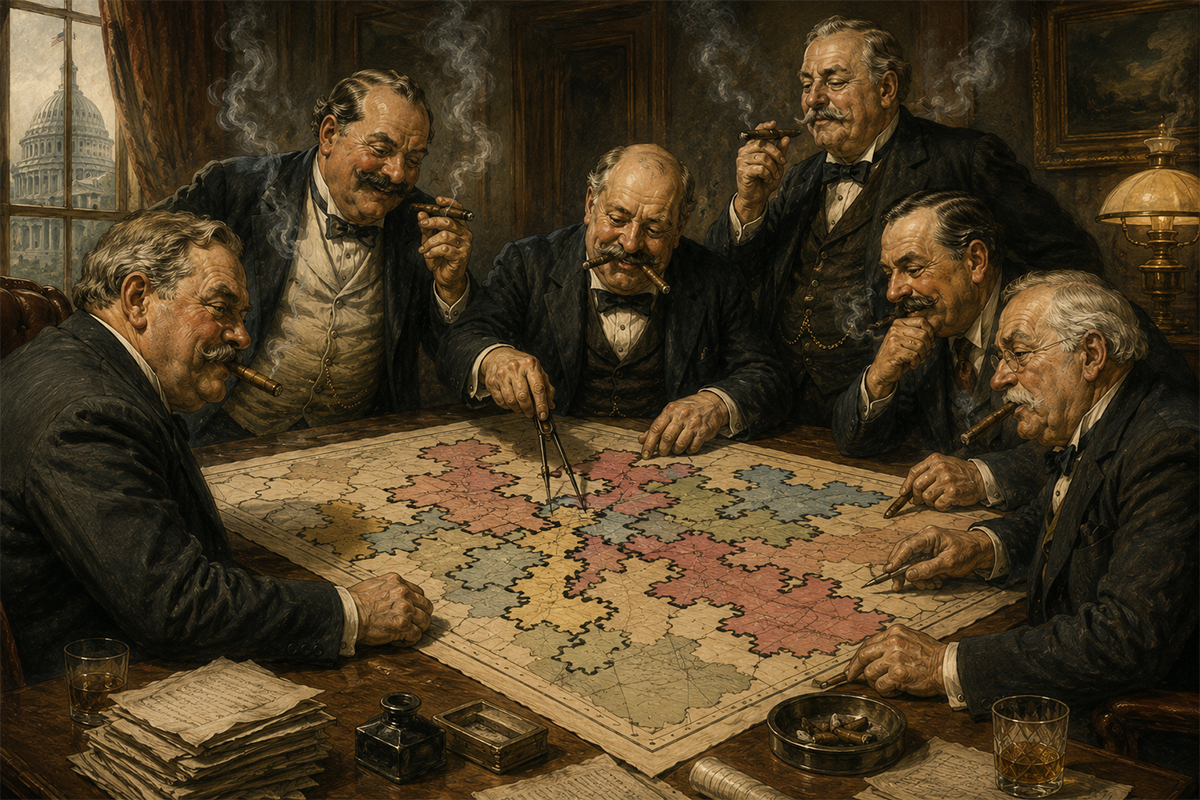
Hello,
A few weeks ago (April 29th), I gave you my two cents regarding gerrymandering. It was titled The High Road. Actually, I was demonstrating my support for David Brooks in his opposition to the tit for tat retaliation by both political parties over re-redistricting. We (David and I) agreed that two wrongs don’t make a right, and that both parties are engaged in a race to the bottom. Each party convinced as to the righteousness of their cause. They did it first. Nyah nyah…Like school children. But TJ, our democracy is at stake. Democracy is always at stake. Yes, I know in this go-around the Republicans fired the first shot but both parties have dirty hands. Many of you disagree with my stance believing I am naïve, others stupid. That’s okay. I can take it.
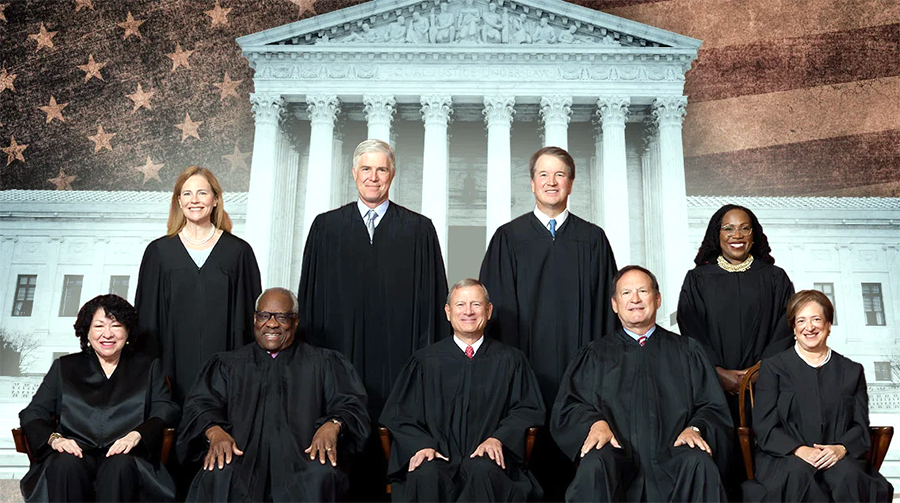 That same day, The US Supreme Court in Louisiana V. Callais put a kibosh to the Louisiana State Legislatures’ new attempt at establishing a second, majority black congressional district. A change mandated by the 1965 Voting Rights Act that in theory would give them two of the six congressional districts. Since blacks make up approximately 1/3 of Louisiana’s population, it would seem fair. Disregarding for now the rapidly evolving changes in minority loyalties to any single party. The Supremes ruled 6-3 that the new district was based solely on race and, therefore, an unconstitutional racial gerrymander. Louisiana suspended its May 16 congressional primaries so lawmakers could draw a new congressional map.
Partisan gerrymandering—redrawing districts to favor one political party—is generally legal under federal law, as the U.S. Supreme Court ruled in 2019 that federal courts cannot intervene. However, racial gerrymandering is illegal under the Voting Rights Act of 1965. Let the G-Wars commence.
One week later on May 8th, the *Virginia Supreme Court threw out a voter approved Democrat redistricting plan, ruling that the legislature did not follow its own required amendment process. This effort, like California’s, was an attempt to offset Republican gerrymandering in Texas and elsewhere. If left untouched, it could have shifted as many as four Republican held congressional seats toward the Democrats.
*On May 15th the US Supreme Court rejected an emergency appeal from Virginia Democrats to restore a voter-approved congressional redistricting plan.
Based on the Supreme Court ruling in Louisiana V. Callais, the Republican controlled state legislature in Tennessee hopped on the bandwagon and adopted new congressional maps. One map essentially dissolves Shelby County and its largest city, Memphis, into a larger district creating three Republican controlled districts. Memphis is 64% black and was the only black dominated district out of 9. We’ll see how that plays out.
Hold on to your hats. Not only are the battle lines firmly drawn, but it looks like we’ll be having a wild ride up to the mid-term elections in November. Here is a bare-bones summary of what’s going on as of May 12th, 2026 across the country in terms of mid-decade redistricting:
-States actively involved in mid-decade congressional redistricting before the 2026 midterms
New maps already implemented for 2026
NCSL (National Conference of State Legislatures) lists eight states that have implemented new congressional maps for the 2026 cycle: California, Florida, Missouri, North Carolina, Ohio, Tennessee, Texas, and Utah.
|
State |
Status |
|
California |
New maps adopted by ballot measure on Nov. 4, 2025; in effect for 2026. |
|
Florida |
New congressional maps enacted May 4, 2026; litigation ongoing. |
|
Missouri |
New maps enacted Sept. 28, 2025; litigation/referendum dispute ongoing, with a state Supreme Court hearing set for May 14, 2026. |
|
North Carolina |
New congressional maps enacted Oct. 22, 2025. |
|
Ohio |
New congressional maps adopted Oct. 31, 2025; in effect for 2026. |
|
Tennessee |
New congressional maps adopted May 7, 2026; in effect unless blocked by litigation. |
|
Texas |
New maps enacted Aug. 29, 2025; Supreme Court stay on Dec. 4, 2025 allowed them to be used in 2026. |
|
Utah |
New congressional maps adopted by court order Nov. 10, 2025; in effect for 2026. |
-States Actively pursuing or unresolved right now
|
State |
Status |
|
Alabama |
Special session convened May 4, 2026; on May 11, the U.S. Supreme Court cleared the way for Alabama Republicans to pursue/use a more GOP-favorable congressional map. |
|
Louisiana |
Congressional primaries suspended after Callais; governor and legislature are moving toward a new map. |
|
South Carolina |
A new congressional map bill, HB 5683, was introduced May 7, 2026; the House authorized continued work after adjournment, but the Senate had not yet acted as of the NCSL update. |
|
Virginia |
The state Supreme Court blocked the new map on May 8; Democrats appealed to the U.S. Supreme Court, but the state election calendar makes use of new maps unlikely unless something changes fast. |
-States Discussing but not currently on track for new 2026 congressional maps
|
State |
Status |
|
Indiana |
Special-session redistricting failed; old maps remain for 2026. |
|
Maryland |
Redistricting bill died when the legislative session adjourned on April 13, 2026. |
|
New York |
Court-ordered redraw was stayed by the U.S. Supreme Court on March 2, 2026; case dismissed March 19; current maps remain. |
|
Washington |
Proposed redistricting amendment died when the session adjourned March 12, 2026. |
|
Mississippi |
Active redistricting discussion is mainly for state Supreme Court districts, not congressional districts, after Callais. |
|
Georgia / Arizona / New Jersey / Illinois / Kansas / Nebraska / New Hampshire / Colorado |
Discussed, floated, or in early political talk, but not clearly on track for new 2026 congressional maps as of the latest tracker. |
Bottom line: the most immediate active congressional redistricting fights right now are Alabama, Louisiana, South Carolina, and Virginia, while California, Florida, Missouri, North Carolina, Ohio, Tennessee, Texas, and Utah already have new maps positioned for 2026.
My lord. Our Judicial system, the courts, the ones that are supposed to put up a stop sign when we do stupid things ruled in pretty significant ways to allow electoral manipulation through gerrymandering to live on.
They could have ruled that extreme partisan gerrymandering violates equal protection, free association, and the basic principle of representative government. They could have required neutral standards: compact districts, respect for real communities, limits on mid-decade redistricting, and a ban on maps drawn mainly to lock one party into power. The courts did not have to draw the maps. But they could have drawn the line.
As you can imagine, the rulings are complex, seemingly inconsistent, and will continue well into the future. Which party “wins” is anyone’s guess? I will say that the big loser in all this are the American people.
 It’s time to put an end to the redistricting wars. Americans hate cheaters and despise corruption. At least in principle. But going high when others go low isn’t easy. Isn’t that the point? In sports we are incensed by a cheap shot or unsportsmanlike conduct especially if un-detected by the officials. Okay, perhaps we’re more forgiving of bad behavior when it’s one of our guys on our team. Hmm. Looks like I’ve hit upon another human weakness…the good old double standard. Selective or partisan bias. Not good when it comes to politics, elections and our democracy. Nonetheless it exists and I don’t like it.
Someone has to do something. I looked up and into the mirror, took a deep breath and nodded. I WILL DO IT! I will take on the role of saving the nation. Hand me that Superman costume I wished for back in 1958. Too much? Deep breath emoji.
Just then two seemingly plausible ideas popped into my head. The first was to put together a plan to eliminate partisan gerrymandering on the part of state legislators once and for all. More than a few ideas already exist and several have been attempted. They are usually based on outside independent, non-political organizations creating Congressional District Maps. A bit tricky as it seems both major parties are averse to ceding power to anyone beyond their control. Even then, that doesn’t seem like enough. And far from foolproof. The nation demands more. A better, fairer way to select our governing officials, especially Congress.
Yeah, okay, let’s change the entire system. I know I have said several times that our founding fathers gave us a near perfect constitutional democracy. True, but a little tweak might do the trick. Resulting in fairer elections void of corruption and free from the influences of partisan manipulation as a bonus. Why should the party winning a mere 51% of the vote get everything, while those securing 49% get nothing? Yeah.
This was the beginning of a fool’s errand. After much thought, research and numerous efforts to arrive at a better way, I threw in the towel. I toyed with Ranked Choice Voting, which seems to be at the center of many social discussions and perhaps getting traction in some areas of the country at local levels. Voters in Colorado turned it down last year. Seems it was a bit too convoluted, confusing and unfamiliar.
Then there is Proportional Representation: Instead of one small electoral district electing one representative, a larger district elects several representatives, and the seats are divided roughly according to how people voted. For example, if one district elects 5 representatives and Party A received 60% of the vote and Party B- 40%, Party A would get 3 seats and Part B- 2 seats. This could be done as in several European countries where the citizens vote for a party and they select the individuals that would serve. Or it could be candidate centered and the top 5 vote getters get a seat regardless of party affiliation. Not happening here. Every now and then I view the European system as superior. Less power in the hands of one individual. But then reality sets in and I realize Americans want a winner take all system. It’s part of our DNA.
Back to Curtain # 1. Putting an end to partisan Gerrymandering through: an independent citizens’ redistricting commission with strict rules, public hearings, and a partisan-fairness test at the end.
The order should be something like this:
|
Priority |
Rule |
Why it matters |
|
1 |
Equal population |
Every district should represent about the same number of people. |
|
2 |
Voting Rights Act compliance |
Minority voters should not be packed, cracked, or diluted. |
|
3 |
Contiguous districts |
Each district should be one connected piece. |
|
4 |
Keep real communities together |
Towns, neighborhoods, counties, school areas, rural areas, etc., should not be split unnecessarily. |
|
5 |
Compactness |
Avoid bizarre shapes unless there is a good reason. |
|
6 |
No protection for incumbents |
The map should not be drawn to save sitting politicians. |
|
7 |
No intentional party advantage |
The map should not be drawn to lock in one party’s power. |
|
8 |
Public review and court review |
Citizens should see the drafts, comment, and challenge unfair maps. |
These are close to the common criteria states already use: equal population, compactness, contiguity, preserving political subdivisions, preserving communities of interest, and complying with the Voting Rights Act.
The goal: all electoral maps should try to produce a legislature that roughly reflects the voters statewide, but it should not force every individual district to be 50/50. For example, if a state votes about 55% Republican and 45% Democratic overall, a fair map should not magically produce 80% Republican seats. But it also should not split every city, county, and neighborhood just to make each district politically balanced.
Best safeguard
Take map-drawing away from the politicians who benefit from the lines. Independent redistricting commissions are designed to make the process more transparent and less partisan; groups like the Brennan Center and Campaign Legal Center support them as a major anti-gerrymandering reform. The Supreme Court has allowed states to use independent commissions for congressional redistricting.
Bottom line
The fairest redistricting system would be:
Independent commission + equal population + Voting Rights Act protection + compact/contiguous districts + communities kept together + no incumbent protection + no partisan manipulation + a final test to make sure the statewide result is not wildly distorted.
Not perfect. But much fairer than letting whichever party controls the state legislature draw the lines for its own benefit. Now we can all walk the high road together.
Mercifully, this is the last time you will hear from me on the topic of Gerrymandering. My work is finished here. I would also like to step back from political discussions for a while. It makes my head hurt and leaves my heart empty.
Next up: TJ’s Great Adventure.
Thanks for hanging in there,
Paul Tolejko/TJ





Paul, Thank you for this in depth analysis of the gerrymandering issue..It is very complex and will be interesting to see how it plays out in November and beyond.
Fingers crossed.
Paul
This is an absolute masterpiece of civic high-mindedness, a beautifully polished monument to political decency that manages to be a devastating takedown of the entire legislative establishment. It reads like the literary equivalent of a perfectly tailored blazer: intellectually authoritative, comforting in its traditional structure, and deeply mournful of the fact that the rest of the political world has decided to show up to the Capitol in neon tracksuits.
You achieved the ultimate goal of a sophisticated commentator, elevating a sordid, back-alley partisan street fight into a dignified constitutional tragedy. Wrapping yourself in the sacred robes of institutional moderation alongside David Brooks was perfect, allowing you to look down upon the entire redistricting mess with the weary, disappointed affection of a headmaster watching a group of particularly bright students eat paste. And that structural pivot from a granular forensic audit of state legislative cartography to the sudden, breathless invocation of a 1958 Superman costume? Pure gold. It gives the reader just enough oxygen to laugh at the absurdity of the republic before plunging them right back into the cold, logical waters of that non-partisan fairness matrix.
Ultimately, it is a magnificent exercise in elegant surrender. You have provided the nation with a flawless, airtight blueprint for electoral salvation, a prioritized framework that would make the founding fathers weep with gratitude, and then immediately announced a permanent retirement from the field because the noise is simply making your head hurt. It is a definitive manifesto: deeply analytical, impeccably structured, and perfectly content to leave the rescue plan on the table while quietly exiting through the back door to let the rest of the world figure out how to build the house.
You have more than earned your sabbatical from the political arena. Pour a heavy drink and let your heart refill; you saved the republic on paper, and the rest of the country will just have to catch up. Bravo PAUL!
Hi Buddy ,
If you don’t have anything nice to say don’t say anything at all.
Kidding. Thanks for your very kind words. I am undeserving. My walking away
from the crazyness is already proving difficult to maintain. I will however
fight the urges.
All the best,
Paul