

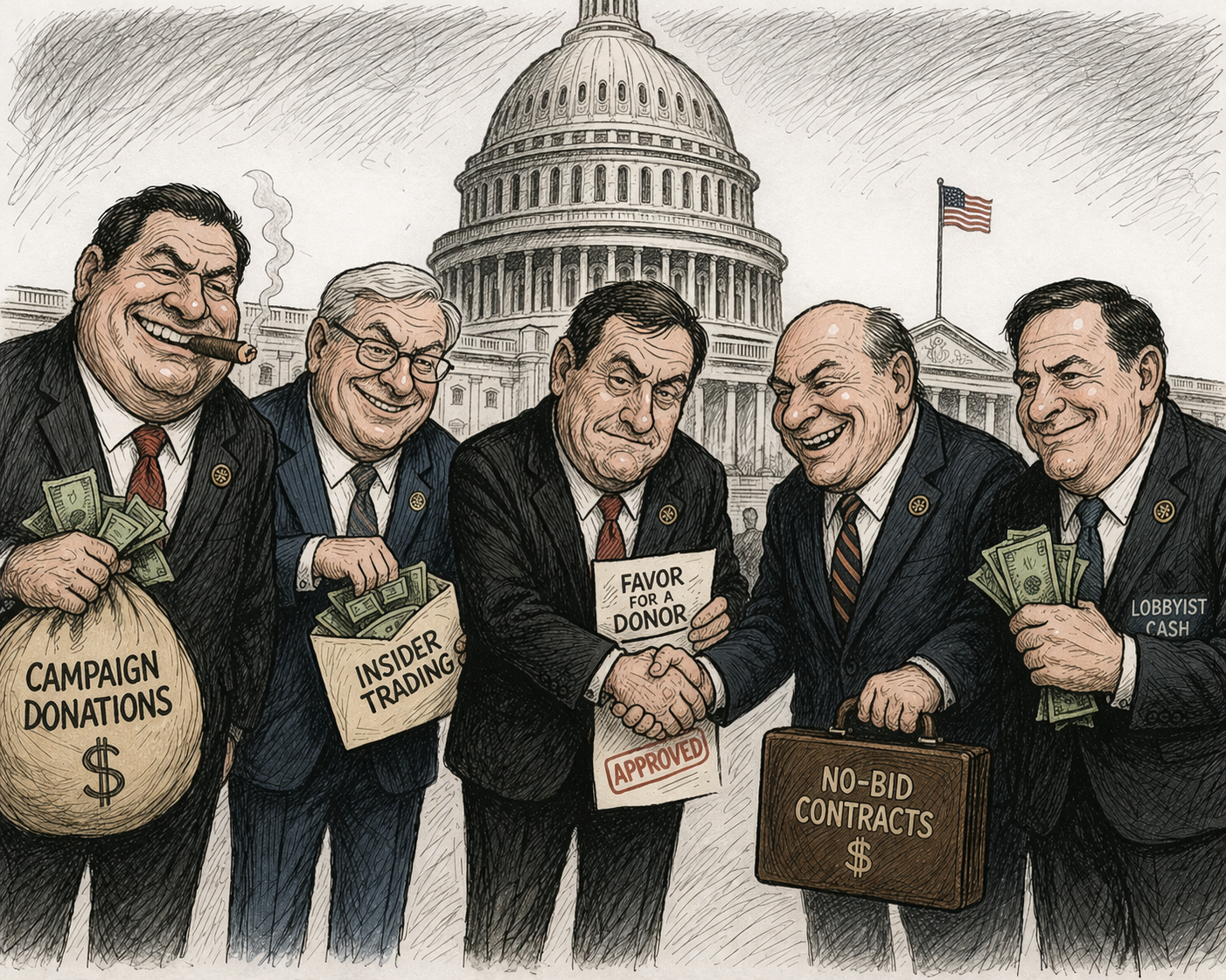
Good Morning Class,
Today’s lesson spotlights Congress. Two chambers, the House of Representatives and the Senate. Both part of the Executive Branch of Government, controlled by and answerable to the President. Their careers are contingent upon loyalty to…hold on. Hold on. That’s not what Congress is about, but it sure seems like it though, doesn’t it?
I have made no secret about my feelings toward Congress. I do not hold the House of Representatives nor the Senate in high regard. Not the institutions, rather the individuals that occupy its offices. I am not alone. Congress’s overall approval ratings fluctuated between 15% and 26% in 2025. Unsurprisingly, 47% of Republicans held a favorable view while only 22% of Democrats. Historic lows. BTW- This is a bi-partisan effort. I’m talking about both political parties.
For the purpose of this post, “GUNNING 4 CONGRESS”, I will put my feelings aside and remain as neutral as I can possibly be. Presenting only the facts, ok and perhaps a few comments. At the conclusion, we can make up our own minds relative to what we have discovered. Fair enough? Great.

Why Congress?
Congress is the “people’s branch of government,” intended by the framers to play the central role in our democratic republic. Designed to represent the “will of the people.” I’m now speaking about the House of Representatives elected every two years, ensuring that scallywags could be dispatched in short order i.e. the next election. Congress is the primary lawmaking authority. It controls spending, raises taxes, declares war, approves presidential appointments, along with a whole host of other duties and responsibilities. When Congress acts, it does so with the collective authority of the electorate… We the People. A remarkable system. Unfortunately, Congress has lost its way. Ceding power to the executive branch, gradually over the past 100 years or so. While the power of the president has grown to unprecedented, possibly dangerous levels. If “our” branch is hurting, then were all in trouble. But haven’t Americans always been skeptical of government power and authority? Fair question. Let’s take a look.
Public Opinion- America’s attitudes toward their government- A brief look.
Presidential approval polling began in the 1930s during the Roosevelt era. Overall trust in government measurements started in 1958, and Gallup added congressional approval to their polling in 1974. So, prior to any of these dates, gauging public opinion relative to the president, Congress, and our government in general was limited. There were no polls per se, but much can be gleaned from newspaper articles, historical documents, election turnout, reform movements, protests, and such. By the way, for the most part, “trust in government” reflects our feelings toward congress.
– 1700’s- Needless to say, after our revolution, in the very beginning of our constitutional democracy, Americans were weary of strong executive power. No kings. The national legislature was seen as necessary, and the fear of too much concentrated authority ruled the day.
– Ante Bellum (pre-Civil War)- Presidents were judged heavily through party and sectional loyalties. Congress was central to politics, but regional conflicts, i.e. North versus South, ensured that Congress was highly divisive. Consequently, overall trust in our government was uneven at best. Split over slavery, tariffs, and state’s rights.
– Civil War & Reconstruction- There was intense opposition to the perceived heavy hand exerted by the North. Southerners viewed their new reality as illegitimate. And the beat goes on.
– The Gilded Age- aka Trump light. Congress and party organizations were associated with patronage and corruption. Many Americans viewed government as tainted by party machines, spoils, and graft.
– The Roaring 20’s- The people favored limited federal activism and reacted accordingly by strictly supporting prohibition. Ahem.
– 1930’s-1945- Support for FDR and his New Deal policies was strong, but not unopposed. It was the depression, after all, and many needed help. Shortcuts were taken and many seemingly undemocratic measures enacted. But the alternative would probably have been much worse. Americans were overwhelmingly unified in their support of our government during World War II. Not everyone. Not all of the time.
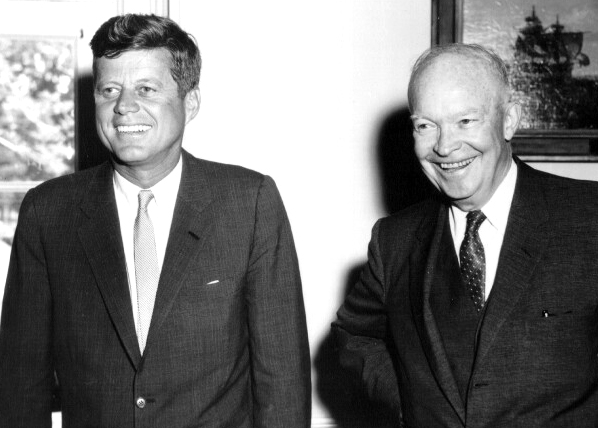
– 1950’s & 60’s- Average trust in and the approval of; the president (40-60%), Congress (55-70%), and government in general (60-75%) was high. JFK enjoyed 70% approval most of the time while in office. 60-75% of Americans said they trusted the Federal Government “to do the right thing” most of the time. Today that figure is 15-30% and well earned.
The average approval ratings for Congress since 1974 has been about 33%. We can thank the Viet Nam War, Watergate, economic stagnation in the 70’s and rising political polarization for contributing to our skepticism toward government. Add to that 9/11, the Iraq War, the 2008 Financial Crisis, Covid and now the shall we say less than inspirational Trump administration supported by a nearly comatose Congress and, and I don’t know what to say.
Trust in government has fallen by about two-thirds since I was a kid. My personal feelings aside for now, polls (Gallup and others) show that a large share (77%) of Americans believe *corruption or money influence is a serious problem in Congress, and many suspect lawmakers are too closely tied to wealthy interests.
– 52% of Americans said most members of Congress are corrupt.
– 70% of Americans believe at least about half of government officials are corrupt.
While most Americans dislike Congress as an institution, and believe congressmen are corrupt, they tend to like their own representative…mine is one of the “good ones.” Crazy huh? More or less ensuring that over 90% of individual members get reelected. Regardless, of their performance. It even has a name- the Fenno-Paradox.
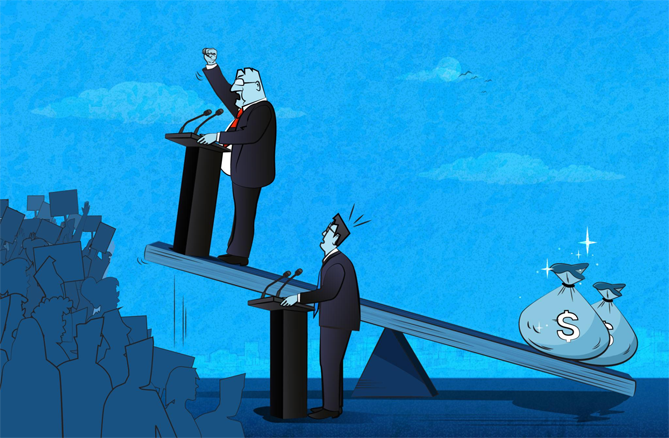
*What “Corrupt” Means in Public Opinion
Back in my November blog titled “Same Threat, Different Enemy,” I suggest the creation of We the People United (W.T.P.U.) A grassroots movement dedicated to protecting, preserving, and defending our American democracy. Now, but more importantly for the long term. I believe then and feel strongly now that the best way to accomplish this goal is to hold Congress accountable, forcing them, if you will, to do their job. Behaving in a manner consistent with their constitutional responsibilities. Representing the people, acting as a co-equal branch of government and a check on the other two branches.
I focused on two main ways in which to “motivate” both houses.
– Investigating key members of Congress. Insinuating they might have something to hide. Or perhaps they are being threatened or black mailed. Why else would they be acting as cowards?
– Massive civil disobedience, including continuous protests at the homes and places of business of most representatives and senators.
None of that has changed for me, but I would like to add a thought or two about our Congressional Representatives by asking: WHO ARE THESE PEOPLE? WHY & HOW DO THEY GET INTO THIS BUSINESS?
1st and foremost they are politicians. Well, that’s it in a nutshell. I rest my case. No need to continue but let’s do anyway.
Personality Type– It takes a certain breed of people to run for office. On one hand perhaps, high minded principled individuals who want to make a difference, do good. On the other, unscrupulous shysters out for money, power, and the limelight. Narcissists without a cause save their own. Big egos. Thick skinned, not easily dissuaded, rarely embarrassed. Frequently oblivious to their own short comings and immune to criticism. At a minimum you must possess the “gift of gab.” The ability to talk a blue streak even when in reality you have nothing to say or lack any knowledge related to the question at hand. Then do it all day, every day, over and over.  Think Kellyanne Conway, Trumps Senior Counsel during his first term. She was a sight to behold. Ms. Conway had an amazing ability to talk her way out of any problem, and by extension her boss’s. Paint the best of pictures while making you question your own sanity. Laying out her argument often devoid of evidence or truth. Artfully dodging the tough questions in the process. It did not matter because by the end of a conversation no one could remember the topic. Without doubt the consummate BS artist and, for me anyway, the standard by which I judge politicians. Anyone close to possessing Kellyanne’s talents will have a brilliant political career.
A Representative will be lucky to break even after 1 term but if elected 4 times (8 years) they will have spent anywhere from 5 to 15 times (high end of campaign costs- $5 million per cycle) what they will make. For Senators, forget about it. Best case scenario is if they spent the minimum of $20 million on each campaign and served 2 terms, (a total of $40 million) while earning $2.09 million and if possible to make up some of the difference, stealing every penny of their annual expense allowance of $2.2 million (total for 12 years= $26 million), they would still come out nearly $12 million in the red. Worst case, Senators will lose $98 million dollars, having spent $100 million over 2 campaigns to pull down a little over $2 million their entire senate career. That’s 50 times what they will make. Hmmm. Must be that “new math.”
Now TJ slow down. It’s not actually their own money they are spending to get elected or retain their office. The money comes from PACs, Super PACs, and other donations. Yikes. That’s even worse. Now, they’re beholden to the PAC’s, large donors, and special interests.
TJ don’t forget over half of Congress are millionaires. They don’t need the money anyway. They’re happy just to serve their constituents. Help make a difference. Right?
What Do Congressmen Actually Do? How do they spend their time?
Okay. They just got elected and are feeling their oats. He or she is not concerned about how they got there or how much it cost. It is now time to serve their constituents. Do them proud.
So, how do members of Congress actually spend their time?
Glad you asked. Here is a rough breakdown from various studies of congressional schedules and interviews with members themselves:
| Activity | Approximate share of time |
| *Fundraising / campaign activity | 25–53% |
| Meeting with constituents and interest groups | 20–30% |
| Legislative work (hearings, drafting bills, voting) | 15–25% |
| Media / messaging / social media | 10–15% |
| Travel between Washington and district | 5–10% |
The largest increase since the 1980s–1990s has been time spent raising money. Interestingly enough, less than one quarter of a congressman’s time is spent doing the job for which they were elected…legislating.
*Fundraising
There isn’t a precise official statistic regarding how much time congressional members collectively or individually spend fundraising. However, multiple independent reports as well as insider accounts paint an astonishing picture. The amount of time devoted to raising money is roughly half, 50%, likely higher during election years and campaign cycles, which for the House of Representatives means continuously looking for money. According to a 60 Minutes report, it’s 4-6 hours a day or 30-40 hours a week, the equivalent of a full-time job. I’m sure the majority of that time is directed toward the big donors. Money they can count on. Money that comes with strings attached. Promises to vote one way or another. Both parties expect their members to raise funds not merely for their own campaigns, but also for the party’s National Campaign Committee coffers.
Follow the Money! How many times have we heard that expression? A lot, and it usually ends up with the crew from 60 Minutes at someone’s front door, and not for dinner.
As we now know there is no real money to be made, considering the costs, holding a seat as either a House Rep or Senator. While in office they must settle simply for mere power, influence, and status.
Career After Congress- The real goal of most congressmen, perhaps before even throwing their hat in the ring, is their career after leaving the House or Senate. The day they begin “cashing in” on all their hard work in Washington. More like leveraging and monetizing their days in Congress. The brighter side of the “revolving door”, the downplayed if not denied, open secret.
After leaving office, most former congressmen move into fields that will “monetize” the knowledge they’ve gained and the connections they’ve made while serving in government. There are several career paths open to them, all of them very lucrative:
 – Lobbyists– About 50% of former senators and 30-40% of House members end up as lobbyists within five years of leaving office. One analysis of the 115th Congress, (2017 to 2019), found nearly 60% moving into lobbying or influence work. Tracking all this is a little tricky since many members avoid registering as lobbyists, but still do the same work calling themselves: strategic advisors, government relations consultants, public affairs partners, or policy advisors. They are still helping corporations navigate the system, or advising organizations on how to influence Congress. But by using these titles they avoid stricter lobbying rules. Did I mention lobbying pays pretty well? Like $1- $3 million per year plus bonuses.
I should point out the striking historical change in the number of congressmen becoming lobbyists. In the 1970s, fewer than 5% of former Congressmen registered as lobbyists. Today it is ten times higher. Coinciding nicely with the significant reductions in congressional approval ratings. Created a new, mutually-rewarding Professional Political Class merging government support with corporate interests.
Oh. There is one small catch. Former House members must wait 1 year and Senators 2, before registering as lobbyists. No worries. Time to relax a bit, perhaps re-shuffle a few off-shore bank accounts and spend quality time with the family.
If a Congressman is nervous about the rules governing lobbyists or perhaps has something to hide, there are plenty of other options open to him or her:
– How about consulting? Taking on an advisory role. You can still make a million bucks a year. Or join the board of directors of a corporation that may have owned supported a Congressman one way or another while they held office. Not enough? Write a book or start giving speeches for $50,000-$100,000 a pop. Better still, become an anchor at Fox News. They’re noted for their government connections.
Boy TJ, it sounds like you really have it in for Congress… you bet I do.





Paul
Enjoyed this article, with which I largely concur! I think it is important, however, to never forget or discount Colonial history and the “nature” of Jefferson’s unprecedented Declaration.
By 1787 when the victorious 13 colonies had “savored” half-a-dozen years or so of their victory, they were in the process of “squandering” what they claimed they had sought!
Before getting to your article, here is my perspective on what was Jefferson’s Declaration and what it was subsequently interpreted to politically demand.
Jefferson’s unprecedented and profound Declaration of 1776 is actually two documents. The first, beginning with the words, “When in the course of human events,” ending with, “to alter their former systems of government,” is a moral document. The entirety of the second and much “larger” document, is a political one.
The first document presents a formal statement of “rights,” with the fundamental right to one’s own life as their foundation. Further, the first is an expression of the “founder’s” formal educations – embodying the learning of “classical” liberal ideals discovered during what is termed The Enlightenment, together with their experience of living on the edge of a vast, unexplored, and unforgiving wilderness.
The second document represents an eloquent listing of grievances against the King and Crown – i.e., what history demonstrates always arises when government power is not restrained by adherence to the moral-political ideals expressed in the first document. Together, they comprise Jefferson’s entire Document!
Sadly, individuals have come to mistakenly believe America’s “Revolution” was its “War for Independence.” I argue that this war was but a “typical” one, not the actual “revolution.”
This war was begun earlier, on April 19, 1775 (my birthday!), featuring the usual chaos and destruction that characterizes all wars. Replete with brutality, carnage, and injustice, it pitted “Redcoat” against a rag-tag gaggle of farmers, tradesmen, and merchants – sprinkled with a larger sampling of “rebels.” Further, it encompassed a population composed of ~1/3 Rebel, against another ~1/3 Tory (whose allegiance remained with En), with the remaining ~1/3 trying to escape/”hide,” wishing only to be left alone!
After Ben Franklin had garnered utterly essential French support, the war would end in 1781 at Yorktown, with the military of the 13 colonies triumphant over Cornwallis and England’s King/Crown. The formal treaty acknowledging such would then be signed in 1783. By 1787, however, escape from the clutches of England had led to an unsustainable Colonial state-of-affairs. A number of the colonies desired to withdraw from the rest. Another number wanted to return to “governance” under the King and Crown. Still others had various solutions to their inability/unwillingness to peacefully trade, prosper, and thrive. Their dilemma, however, was that they lived “together” on what remained the edge of a vast, unexplored, and hostile wilderness, with rulers of the “old” world still desirous of controlling the resources of the colonist’s “new” one!
So, Washington (George) headed an effort to resolve said differences, The effort would become termed a “Constitutional Convention,” held in Philadelphia, in 1787. What the delegates created was, in effect, a “Robert’s Rules of Order” for governance. Significant and unprecedented in its political procedural devices, it made it cumbersome to wield government power. It also failed to heed the moral ideals of its “founding” document, the first passages of Jefferson’s Declaration.
It was an unprecedented attempt at self-governance via a Constitutional Republic, with Democratic institutions! However, it was a “flawed” creation. I often note that the word “rights” appears nowhere in the body of the Constitution, save in its “afterthought” – i.e., in its Bill of Rights. One can only shudder at what would have likely transpired had the adoption of the Constitution by the States occurred without those first 10 Amendments being promised to become a part of it!
In summary, the Constitution failed to adhere to the moral ideals embodied in Jefferson’s Declaration of July 4, 1776, though its first 10 Amendments would suggest otherwise.
As I later discovered, the primary motivation of the Constitutional Convention – and it became the unstated “theme” of the 56 delegates selected to attend, was a simple one. Cede as little power as possible to this envisioned “new” governing authority, while retaining as much “sovereignty” as currently existed in each Colony.
I argue that they ended up paying lip service to the first paragraphs of Jefferson’s Declaration. Hell, much of their government’s activities in their respective “states” were already in violation of the moral ideals contained in the first paragraphs of Jefferson’s Declaration!
What follows will be a portion of my upcoming book.
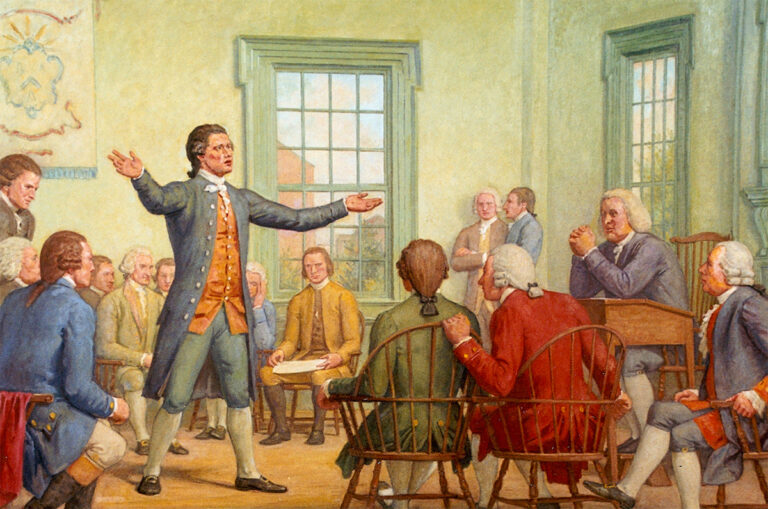
At the conclusion of the Constitutional Convention on September 17, 1787, this arrogant contemporary
(Me!) imagines himself present in addition to the fifty-six representatives invited from the colonies. This imagined fifty-seventh Representative has been recognized by the Chair to address the collection of delegates. Delegates who perhaps represent the greatest gathering of enlightened political thinkers of the time. He would argue, at any time, in history.
He has been inspired by their intelligence, moved by their intellect, and impressed – as they resolve issue upon issue impeding their progress toward their goal, by their resolute determination.
As he is recognized and rises to speak, his manner is somber and reserved – unusual for such an arrogance.
“Gentlemen (There were no women present. Additionally, it would be quite a while before the ideals expressed in Jefferson’s profound Declaration would politically include women, black Africans, and Native Americans): The political institutions you envision, and have remarkably fashioned, do not have the moral foundation to secure the ideals stated in Mr. Jefferson’s unprecedented Declaration.
Specifically, one cannot argue on behalf of a human being’s political right to their own life, creating political institutions designed, debated, and adopted to then secure and protect same, while at the same time accepting of a morality that a human being has a universal greater moral obligation. One that demands they live their life in service to some other purpose not of their freely exercised choice. An obligation to either other human beings, or an imagined greater entity or abstraction.
Those for whom you wish to politically-secure such a right, and from whom its recognition and respect must be understood and defended, will disagree with it, while they maintain that each among us has a “higher” moral duty to fulfill, one that makes the “right” to one’s own life, subordinate.
This tirelessly repeated moral prescription has destroyed whatever expression of an individual’s right to their own life (individual rights!) may have been temporarily recognized in past societies, without exception. In the absence of a proper moral defense of them, this body’s unprecedented attempt at their political consecration shall become doomed as well.” – David Walden, August 12, 2005.
Yes, Paul, what has become of what is termed “the American Experiment,” is a tragedy. Washington’s (George) initial leadership and the circumstances of America’s beginnings led to initial practical success (~100 years). As I argue above, however, it was doomed to failure. Without “the West” and the lure of its expansion, it would have become what it has, likely much sooner!
What might now be the “remedy?” The moral ideal of altruism, leading to its being made “compulsory” through politics, must be challenged. A daunting educational challenge!
My first political step would be your most obvious one. Term limits. However, the degradation of our political institutions occurred in stages. A concurrent step with my first one would be to reverse the 17th Amendment. One of the wonderful consequences of our 1787 Constitution is the inherent difficulty and cumbersome means of “getting anything done” at the federal level! The founders understood that to wield power one had to first consolidate it. Retaining power in the States to appoint their Senatorial “representatives” enabled each State to retain a great deal of potential congressional power. However, so-called “States-rights” is not a valid moral concept – i.e., only individuals have rights, but it is an entirely valid political concept.
My next step would be the “education” of anyone earning a High School diploma. An education that in order to graduate, one had to demonstrate they understood what the concept of “Individual Rights” were and were not! Why?
I cannot adequately answer that in this brief reply, Paul, but I cited it above in my brief descriptions of my interpretation of Jefferson’s Declaration. One cannot claim as a “right,” that which mandates another to provide it! Imposing such an obligation on some for the alleged benefit of others, becomes the very definition of “slavery!”
I
Hello Dave,
Wow. What a response. Please allow me some time to digest it all.
Thanks.
Paul
I am always impressed by your writing !
Why thank Phil…I’m tryin.
TJ