In 2020, Democrats won a convincing election victory. They proceeded to do what all victorious parties do. They passed legislation in accord with their priorities, including raising health insurance subsidies to families making above 400 percent of the poverty line. They wrote the law so that the subsidies would expire in 2025.
In 2024, the Republicans won a convincing election victory. They proceeded to do what all victorious parties do. They passed legislation in accord with their priorities, including letting the Democrats’ insurance subsidies expire as planned.
If the Democrats were a normal party that believed in democratic principles, they would have planned to go to the voters in the next elections and said: These Republican policies are terrible! You should vote for us!
But of course that’s not what the Democrats decided to do. Instead, they shut down the government. Why did they do that? Because we don’t live in a healthy democracy. We live in a country in which the norms, beliefs and practices that hold up a democracy are dying even in the minds of many of the people who profess to oppose Donald Trump.
Daniel Patrick Moynihan once wrote an essay called “Defining Deviancy Down.” His core point was that when the amount of deviant behavior rises, people begin to redefine deviant behavior as normal. This is a column about that.
In a functioning democracy, a politician’s first instinct is to go to the voters and let the voters decide. In a diseased democracy a politician’s first instinct is to amass power by any means necessary. In a healthy democracy politicians abide by a series of formal and informal restraints because those restraints are good for the nation as a whole. In a diseased democracy like ours, all the decent rules and arrangements are destroyed. Anything goes.
Trump is destroying democratic norms. Democrats have decided to follow him into the basement. When both parties cooperate to degrade public morality, then nobody even notices as it’s happening.
Government shutdowns became a thing during the Carter administration. The first few shutdowns during the Reagan administration lasted a day or two. Leaders in both parties did not want to face the wrath of voters who would be offended by this level of gridlock and incompetence. Now we’re in our 20th shutdown (depending on how you count them) and nobody cares. Neither political party is paying much of a price because the public has been rendered utterly cynical about government. Nothing is shocking anymore because there are no moral norms left standing.
Let me try to illustrate how deeply this cynicism has penetrated the American mind. When Democrats did decide to shut down the government, they could have done it to protest Trump’s historically unprecedented assault on democracy. But instead the Democrats decided to organize their messaging around the expiring health insurance subsidies. Why did they do that? Because they calculated that the American public doesn’t care about democracy’s degradation. It’s been going on so long voters are simply inured to it. So better to talk about Obamacare.
And in fact there are good reasons to think that Americans simply don’t care about their democratic rights. For example, several states are redrawing congressional district maps to come as close as possible to eliminating competitive races. If you live in Texas or California, then you probably will not have to vote in November 2026. The district maps will have been redrawn in a way that makes House elections largely predetermined. By then you will probably have been effectively disenfranchised.
You might think that proud Texans and Californians would be outraged, or that the ruling parties in those states would be destroyed for doing this. Didn’t our ancestors at Valley Forge and on the beaches of Normandy die to preserve our democracy? But do you hear an outcry? No. It’s just crickets. People are used to the idea that the game is already rigged. So what is there left to get upset about so long as your party is ruthless enough to do the rigging?
I don’t think I appreciated how much a democracy depends upon regular people standing up to defend their rights and their powers against the elites who try to usurp them. These days people are happy to give up their rights and power if they can find some strongman or strongwoman willing to take it. This is a much larger part of human nature than I thought.
For example, when I first started covering Congress, in the 1990s, backbench members could pass legislation if they had a good idea and some entrepreneurial mojo. Back then, congressional committees and their chairmen were still powerful. Power was dispersed, in true democratic fashion.
But for at least 30 years members of Congress have been content to give away their power. First, they gave the power to leadership, so that today four people basically run the legislative branch. Then they gave power to executive branch agencies, letting more and more key decisions get made by the unelected civil service.
Today if you are a Republican you have basically given away all your power to Trump. You are a duly elected representative of your constituents, yet you’ve turned yourself into a Trump bobblehead figure who gets to go on Fox News from time to time.
The blunt truth is that a lot of Americans don’t find our founding ideals sacred, so they don’t get upset when the Constitution is trampled, so long as it is their side doing the trampling.
Let me try to describe something that may seem trivial but which I believe is at the core of our rot. It is politicians’ tendency to use the word “fight” in their campaign rhetoric. I noticed this trope when Hillary Clinton ran for president. She was continually promising to “fight” for middle-class Americans. It didn’t bother me then. She was a woman running for an office that had been held entirely by men, so she had to prove she was tough.
But now the “fighting” rhetoric is ubiquitous. MAGA Republicans claim that the old Bush-era Republicans were squishes who didn’t really know how to fight. Democrats are upset with their party leaders because they don’t fight hard enough. Political analysts casually use phrases like “he brought a knife to a gunfight.” I hear “fighting” references constantly in political discourse, and every time I do alarm bells go off.
This is no longer just a metaphor. It’s a mind-set. We now have a lot of people in this country who do not believe that democracy is about trying to persuade people, it’s about fighting, crushing and destroying people. I don’t agree with the philosopher Michel Foucault on much, but he had a point when he observed that a lot of life is about trying to repress the little fascist in each one of us. When people start describing politics as a fight, they are unleashing their inner fascist. Fighting is for fascists.
Democracy is about persuasion. Our Constitution is a vast machine that is supposed to increase the amount of deliberation, conversation and persuasion in society. Our elections are supposed to be raw, rollicking persuasion contests.
Trump’s idiotic rhetoric is not about persuasion. The Democrats’ mind-numbingly repetitive talking points are not about persuasion. The people who want their leaders to “fight” harder just want them to shout their side’s orthodoxies at higher and higher volume. They just want their leaders to ramp up the bellicosity of their rhetoric so that the extremists on their side feel good.
What defines extremists these days? It’s not that they hold ideological extreme positions. It is that they treat politics as if it were war. They use the language, mental habits and practices of warfare. They are letting their inner Mussolini out for a romp.
Let me give you one quick example of how widely this corruption has pervaded our society. Universities were once about persuasion, truth-seeking and the life of the mind. But over the past half century an ideology has spread through them that holds that persuasion is naïve. Ideas are about power. Thus many professors decided their job was indoctrination, not truth-seeking. To impose power so that students think just like they do.
Jon A. Shields, Yuval Avnur and Stephanie Muravchik recently published a study in the magazine Persuasion looking at college syllabuses. As you’d expect, professors assign a lot of left-wing books like Michelle Alexander’s “The New Jim Crow,” about the criminal justice system and race, that align with the official orthodoxy of academia. But there are a lot of other books that dispute the historical claims of books like “The New Jim Crow.” You might think that some professors would assign books on both sides of the issue so students would learn how to weigh evidence and be persuaded. But the researchers estimated that “less than 10 percent of professors assigning Alexander’s book actually teach the controversy surrounding it.”
Students are completely aware that they are not being educated; they are simply players in a cynical indoctrination game. At Northwestern and the University of Michigan, 88 percent of students told researchers that they pretend to be more progressive than they are because they think it will help them succeed academically or socially. I saw exactly this kind of performative dishonesty while covering the Soviet Union years ago.
Yes, Trump is launching an assault on democracy. But what worries me more is what has happened over the last few decades to the rest of us. There has been a slow moral, emotional and intellectual degradation — the loss of the convictions, norms and habits of mind that undergird democracy. What worries me most is the rot creeping into your mind, and into my own.



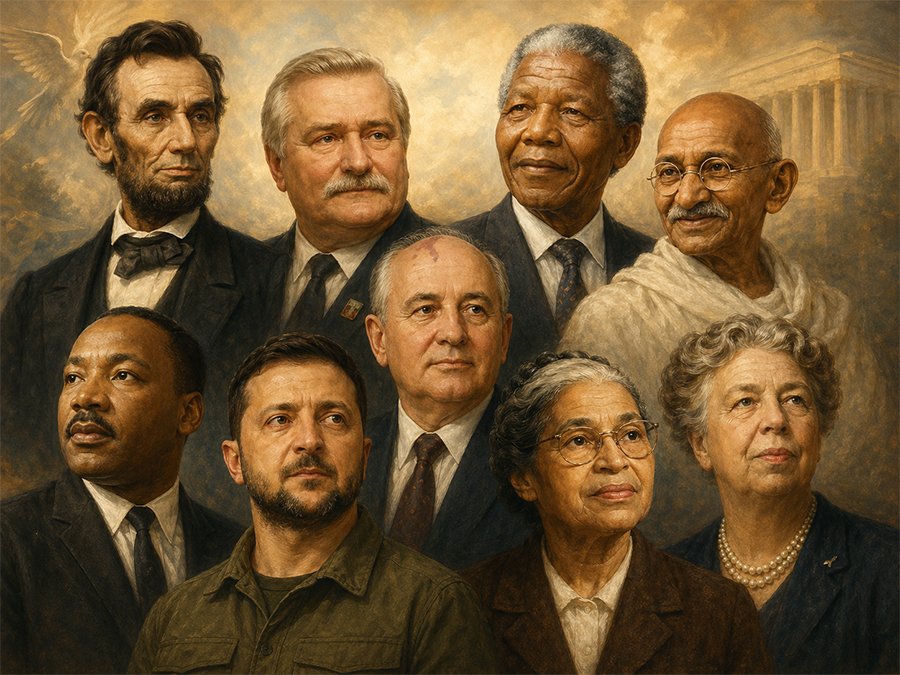 Here are a few that come to mind. Abraham Lincoln, Lech Walesa, Nelson Mandela, Mahatma Gandhi, Mikhail Gorbachev, Martin Luther King Jr., Vladimir Zelensky, Rosa Parks, and Eleanor Roosevelt to name a few.
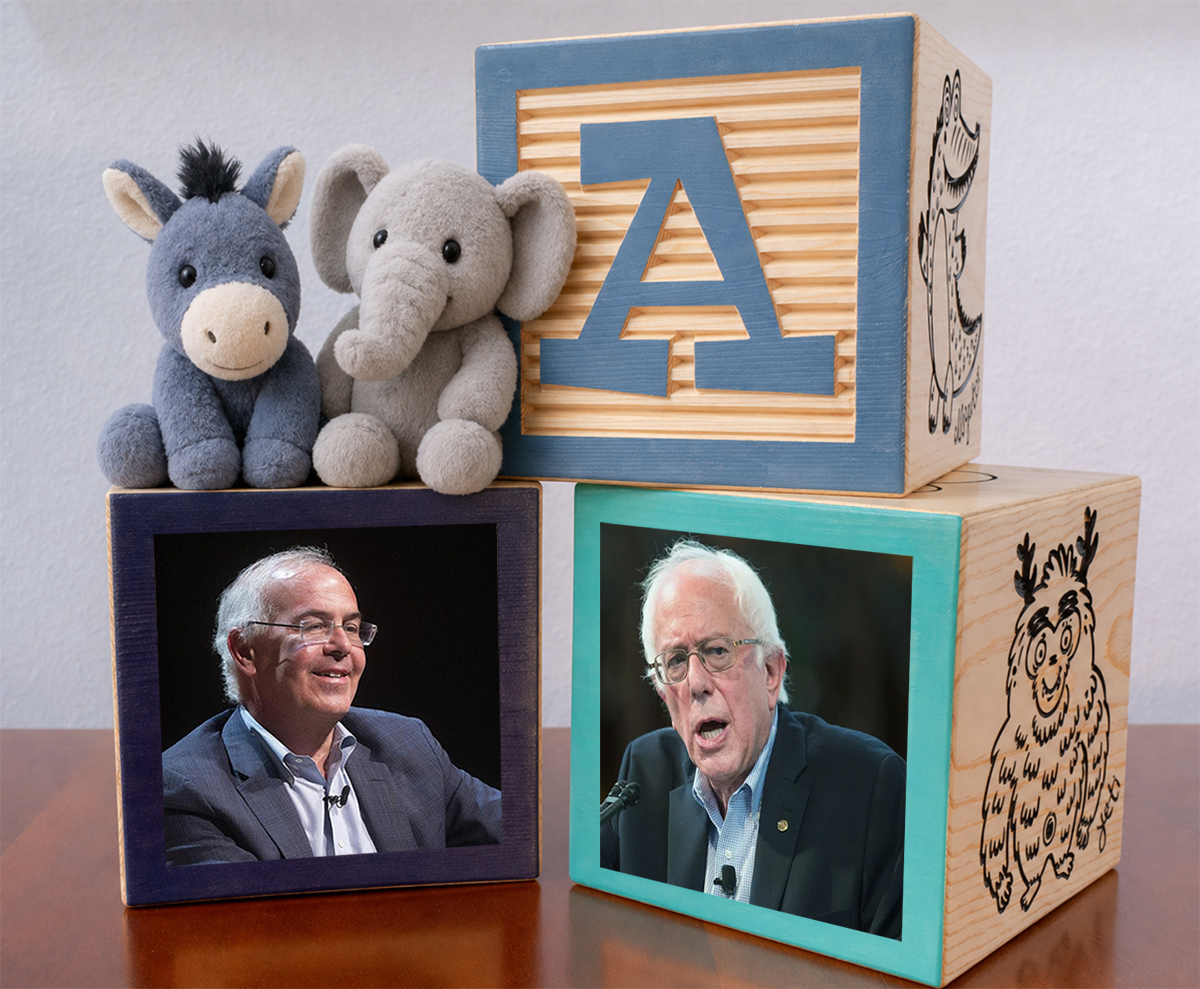 Bernie is urging top democrats to require candidates to reject super PAC support, i.e. money, in upcoming primaries, or lose access to party resources. “If the Democrats are going to be honest and consistent in terms of their concerns about money and politics, they’ve got to clean up their own house’. Hear, Hear. What better way to continue the battle against the corrupting influence of money in politics than by setting an example, taking the long view. My hat is off to the Senator.



Hi, Paul,
I appreciate your thoughts on this, and there is much to agree with. I’m not in a good position to make a full reply but would add a couple of thoughts:
–Americans allowed Trump and Trump Republicans to happen through decades of taking our democracy for granted, not taking seriously the threats that appeared on the horizon. That doesn’t help now, but as we struggle to right the ship, it’s important to keep in mind.
–More to your specific point, I like Brooks on the whole, but I do think he is naive about power. I’m not sure his critique gives us a road map or a strategy to save and strengthen our democracy. Not for the first time, he is telling us what is wrong, but not offering a practical way to correct the situation.
Thanks for sending this around and urging us to think together.
all the best,
jeffrey
Gosh darn you, Jeffrey Richardson,
Here I was firmly entrenched in my moral high ground, basking in the glow of another’s willingness to propose ethical adherence to higher standards. How dare you bring me back to reality? I thank you for doing so. For reminding me that while ethical behavior is something everyone should espouse to, behaving morally is a personal choice and honorable in its own right. Yet, not everyone shares the same definitions. There’s also a tendency to project one’s own virtuous code onto others. It’s much easier to have expectations of others’ behavior than to practice what we preach.
Our world is complex and filled with conflicting values. It is difficult to know how to feel, let alone how to react to situations beyond our control. The truth has many sides, even if the facts are a lone reality. Better to remain silent, leaving action to others.
I am confident that David Brooks is well positioned to appreciate the repercussions of holding high moral ground while ceding power to those that opt for winning at any cost. Up to and including the destruction of their very souls.
You are right to think that David does “not have a road map nor strategy for saving, reclaiming or strengthening our Democracy” when arguing against joining the Republicans in a race to the bottom of party politics. He does however have bigger ideas:
Brooks has argued that America needs a broad, cross-institutional civic uprising against authoritarian behavior — not just normal party politics. In The Atlantic, he wrote that many business leaders, universities, and institutions privately oppose Trump’s damage but publicly lie low because they fear being crushed if they stand alone. His answer is a mass movement that gives people and institutions protection in numbers. His hope is to create enough public solidarity that people, universities, businesses, churches, lawyers, local officials, journalists, and citizens stop acting alone and start standing together.
On PBS/RealClearPolitics, Brooks said that by 2030 America may have almost no swing districts left, which would mean voters have little chance to punish bad behavior. Then he said it would be up to a post-Trump president to treat this as a national problem and solve it “all at once with a coalition of states by redrawing the maps”. I assume in a fair, bi-partisan manner.
The weak spot is obvious: what happens before the “post-Trump” repair period arrives? I suppose he does not believe we need an “emergency strategy”.
My Take-
Nothing is permanent or set in stone. A decade is equal to an eternity when it comes to politics. Democracy is difficult. We may have taken it for granted because it allows us to. We become complacent when we can. It seems to be our default. Why? Because we are Privileged, ah my favorite theme. You may recall me saying ad nauseum how we are living in the best of times. Never have so many had so…etc. etc. In short, too many of us are behaving badly. I will spare you my rant.
Our forefathers provided us with the best possible framework, a representative democracy. The Constitution, Bill of Rights, a system of checks and balances, and free press. Now it’s up to us. At times we have managed to behave in a stellar manner. At other times…not so much. I think we’re in between eras and cannot know what is to come. But I have hope.
To forge a better way forward We must…Heck, I don’t know. But I do know it will happen. And we will again be that shining light for all that yearn to be free. Even if we need a pickaxe, a shovel and a million flashlights to find her.
Jeffrey, you have worn me out.
All the best,
Paul/TJ
Hi, Paul,
I appreciate your thoughts on this, and there is much to agree with. I’m not in a good position to make a full reply but would add a couple of thoughts:
–Americans allowed Trump and Trump Republicans to happen through decades of taking our democracy for granted, not taking seriously the threats that appeared on the horizon. That doesn’t help now, but as we struggle to right the ship, it’s important to keep in mind.
–More to your specific point, I like Brooks on the whole, but I do think he is naive about power. I’m not sure his critique gives us a road map or a strategy to save and strengthen our democracy. Not for the first time, he is telling us what is wrong, but not offering a practical way to correct the situation.
Thanks for sending this around and urging us to think together.
all the best,
jeffrey
Paul-
Overturn Citizens United and curtail PACS (as Bernie proposes)
Make districting a process done by an impartial committee in every state
Make it illegal to work in the private sector after political life for any corp with government contracts or governances or as a lobbyist
Raise the age of entitlement for SS and Medicare to 75
Stop insider trading by politicians using real criminal penalties.
Stop the carried interest tax loophole.
Tax the sham offshore accounts of Billionaires.
Don’t haul Kamala Harris back into the running.
Vance and Newsome are not morally equivalent.
Gavin needs go to the higher moral ground, and avoid the woke, virtue signaling lowlands,. Just speak to morality and greed and corruption.
Stop spending so much. We can cut programs without so much pearl clutching by the bureaucrats and the beneficiaries of the programs.
Term limits
Dems have to get back to kitchen table issues.
Get off woke mountain or die on it.
Keep enforcing immigration laws but softly and stop the exile/refugee status ruse.
Create a little airspace between the US and Israel and stop associating with Christian Zionism/Expansionism.
You now have Tom Friedman and Tucker Carlson in agreement. Now that is weird!
Jail all the grifters in political office and their associates.
Start a non military two year service requirement.
Re-frame the military for the wars of the future.
I am also a big fan of. David Brooks.
Thanks for your emails, Paul!
-Peter Link
Hello Peter,
Don’t hold back. Tell me what you really think. There is a lot here to unwrap. So, I will only comment on a few:
* Make it illegal to work in the private sector after political life for any corp with government contracts or governances or as a lobbyist…Good idea if it is Constitutional. I also like the idea of monitoring the finances of Congressmen and Senators for life. Also tricky I hear.
* Amen to amending the tax codes so that the Gazillionairs pay their fair share. No off-shore nonsense. No Capital Gains break.
Jeff Bezos takes a salary of $85,000 a year. The rest is taken as a loan on his stock that never comes due.
* Ouch on SS and Medicare at 75. I’m 76 so no problem. But let’s throw out those that do not need either first.
* How about we also go back and retry Trump for January 6th along with the 1600 he freed….somehow.
* Select the jury now for the pending New Nuremberg trials in 2028.
Thanks for chiming in. I hope you don’t mind if I share your thoughts.
Best Regards,
Paul Tolejko