


My continuing saga- seeking deeper meaning. Of what? To What? Everything and anything. Scratching the surface just isn’t cutting it anymore. As if it ever did.
I’ve walked the trail circling my daughter’s home probably a hundred times. Most often with Natalie’s French and English Bulldogs, Marvin, and Ollie. I’ve also traversed it dozens of times by bike. The views are always and never the same. Much of the route offers up the western slope of the Rocky Mountains, the Front Range to locals, more specifically Indian Peaks. Always spectacular in its majestic beauty, yet ever changing with the seasons, the weather, and the time of day.
The Rockys are my new Pacific, mainly because Deborah required a reference point to get her bearings. The North Star was no help, nor did the fact that Kansas was due east or New Mexico just below our patio. Having grown up in Southern California, the ocean is west. (Except of course in Santa Barabara where we spent nearly 40 years. There the beaches face south.) All other directions could then be determined. Face the Rockies and you were looking west. Very logical and convenient. We still get lost.
I would argue that The Indian Peaks range, stretching over 25 miles across our horizon and nearly sixty miles westward (inland), is the most beautiful section of the American Rockies. I can’t speak to the Canadian portion, but I do thank them for sending us their geese each and every fall. Thousands upon thousands spread everywhere across Colorado, hopping from pond to lake, to reservoir, or wherever they want to be. You usually hear them before they come into view. Squadron size at times or perhaps only a few. I never tire of watching them even if their formations rarely match the expected V.
My awe of the Rockies is as strong today as it was the first time I set eyes on them over a half century ago. Their dominating presence and the power they project is humbling. It can at times make me feel small or insignificant, but also connected to a part of something much larger and more important.
One day not too long ago while walking the loop trail alone, I had an epiphany of sorts. I stopped to admire the view and take in the fresh, crisp air. My eyes scanned the depths of the valleys, hills, mountain peaks, and blue skies ahead. Suddenly, the mountains took on a new dimension. They were more than just a pretty face. Somewhat confusing at first, but then clearly expanding what lay before me into a much wider, larger picture of our earth.
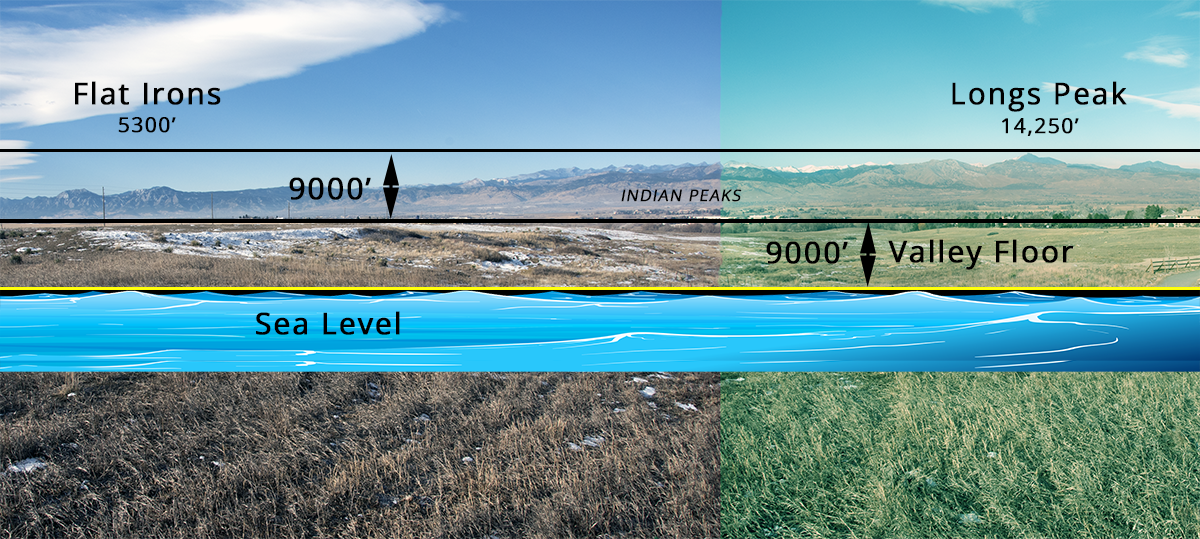
I took note of the city of Boulder off to my left, just below the iconic Flat Irons which I knew to be around 5300 feet above sea level. Off to my right was Long’s Peak. I know it to be 14,250 feet, also above sea level. I noticed Mount Audubon, the very tip of which is visible from one of my living room windows. I wasn’t sure of its height, but I could look that up later. (Note to self: “Ask neighbor to lop off the top of their blue spruces, providing me a better view.”) The same was true of the valley floor along with several other landmarks that would complete my evolving picture. For now, I was content to work with the highest and lowest points in order to obtain an immediate answer to my question: Where is sea level relative to what I’m looking at right now? Okay, envision a line across the highest point, Long’s Peak, continue it south across the sky. Now, mentally draw another, across the bottom, south to north, beginning with the city of Boulder. Take the height of this distance, which I ball parked at 9000 feet, and re-position it underneath the area I just created. Ta da. Drum roll.
The bottom of this height would actually be at sea level. Wow. That’s it? There is barely a difference between the height of one of the Rockies highest peaks and the ocean’s beaches. What a revelation. At least for me. When I explained the process and the mechanics leading to my discovery during a walk with my daughter and grandsons, their response was less than enthusiastic. Something like hmm, that’s interesting, and then we all walked on.
To me this was a moment of discovery. I was jazzed. This is how Galileo or Copernicus or Da Vinci must have felt during their ah ha moments in scientific research. Now what? Like any scientist worth their salt, ok self-proclaimed jr. science lover, with senior citizen privileges, I wanted to expand upon my discovery, realization if you will. But how? What direction should I pursue? I sat pondering my future course of action during breakfast one day, when it hit me. They’re in bold bright letters staring at me from across the kitchen table was my answer…life.
 Yes, life. Not the cereal but the real deal. He works in mysterious ways, doesn’t he? My next move was to examine or, more accurately, re-examine life on earth through my new prism. Kind of like Gulliver during his travels because everything now seemed so small and disproportionate to what I believed was true of the world.
Let’s take this a step further.
All known life (human, animal, insects, birds, plants, bacterial) originated in water, almost certainly the oceans. Skipping over the rest of earth’s geological history, evolution etc. I jump to what we all know but take for granted: Life on earth exists within a very small sliver of our planet.
The earth’s atmosphere technically and legally, whatever that means, stretches out 62 miles into space. AKA The Karman Line. However, about 99% of its mass exists up to 12 miles or 63,000 feet.
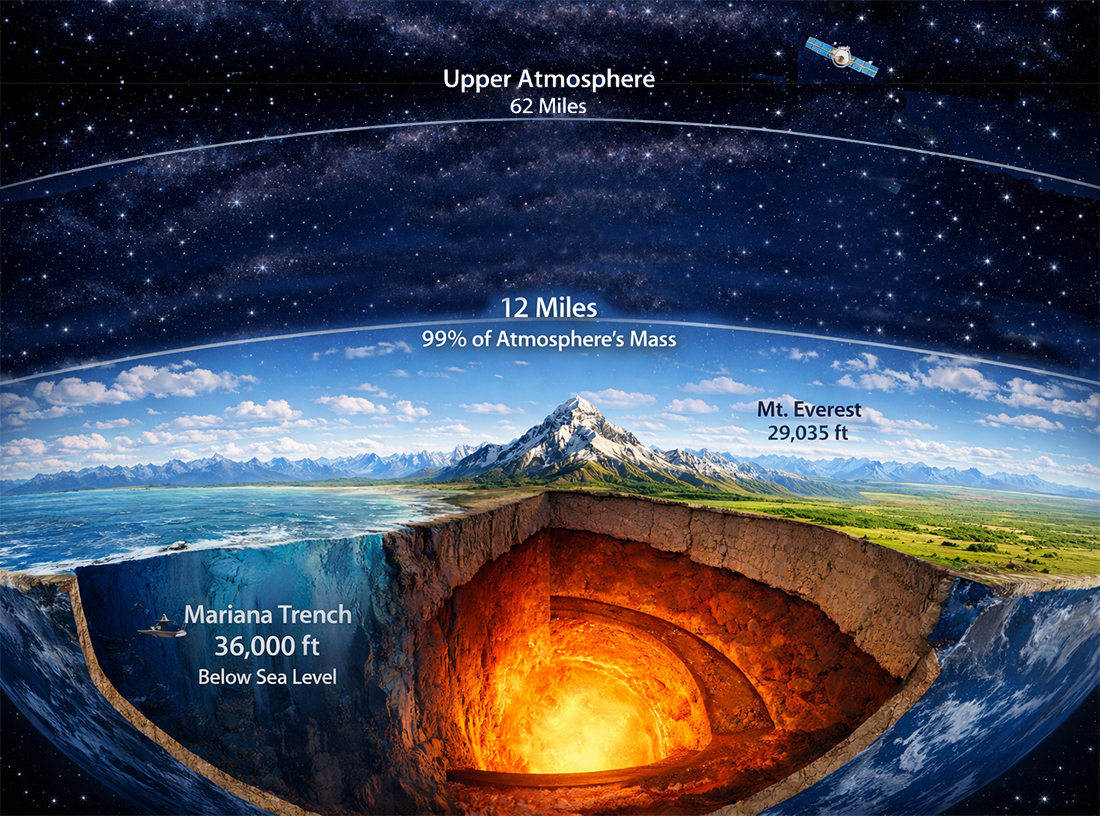 Let’s extrapolate. Okay, the highest point on earth is Mt. Everest rising 29,035 feet above sea level. The lowest point, the Mariana Trench, lies 36,000’ below the Pacific. A difference of 65,000 feet or 12.3 miles. So, basically an area that extends 12 miles above the earth’s surface and *12 miles below or 24 miles in total defines the area on planet earth capable of sustaining life. All life, from bacteria to human. Focusing solely on life above sea level, specifically human life’ for a moment we can lower life sustaining altitudes to the earth’s highest point 29,035’, (Mt. Everest). But wait. You can’t live at 29,035 feet, at least not for long. At that altitude, you’re in what mountain climbers call the “death zone.” Air pressure is only 1/3 that of sea level, oxygen saturation drops dangerously low and the human body cannot acclimatize, cells begin slowly dying due to hypoxia. Not good. Needless to say, you can only fly through areas above this in a pressurized aircraft. The air temperature at 35,000 feet is around -60 degrees Fahrenheit.
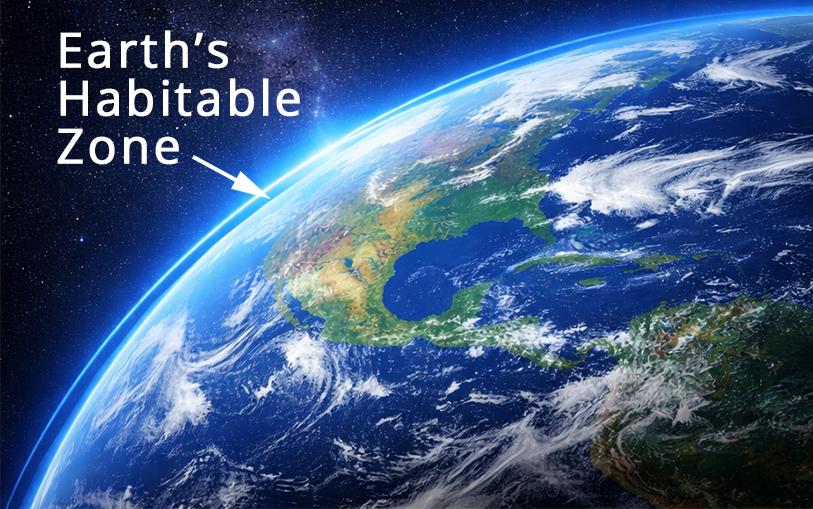 In reality the actual area above sea level that will sustain human life, the “human habitable zone” extends from sea level up to around 8200’ for most people. That is .019% of the Earth’s diameter. A tiny, tiny sliver of the earth. Yes, many people live above this elevation and a lot of us frequently visit higher elevations to ski, hike, explore or perhaps to attend the annual Donkey/Burro Races in Leadville, Colorado. (More later, if I don’t forget.) But given the decreased oxygen levels at higher altitudes, long-term habitation is challenging.
FYI: Almost all (90%+) plants, animals, insects, fungi, and microbes that live on land or in the air do so within 6500 feet of the earth’s surface. 90% of humans live below 3300 feet.
*We’re not going to spend time on living below sea level as we no longer have gills. It is interesting to note however that the overwhelming majority of fish and mammals live within 650-1000 feet of the ocean’s surface where sunlight allows for photosynthesis within algae and plankton, their main food source.
I had breakfast the other day with a friend and neighbor, Dewey, a retired Air Force C-130 pilot. I could tell you a little about his experiences flying Special Ops in the Middle East and Central America, but then he would have to kill me. Over pancakes I mentioned my surprising sea level realization. What once appeared to be sharply uneven continents, rising dramatically above the oceans were now only… so so, at least to me. Oh yeah, he said. That sounds like the “earth is smoother than a cue ball analogy.” What? Oh yeah, I know that. Ah, what do you mean? As it turns out, in between missions, Dewey was a professor of astronautical engineering at the Airforce Academy at Colorado Springs. He taught aspiring cadets how to build, test, and operate spacecraft and satellites… “rocket science.”
He explained the theory. It’s actually not a formal theory per se, but a “comparative roughness argument used by scientists and popularized by NASA to explain Earth’s extreme smoothness relative to its size.” In short, if you shrank the earth down to the size of a cue ball, about 2 ¼”, Mount Everest would be much smaller than a microscopic scratch. Ocean trenches would be imperceptible. Earth would feel smoother than a brand-new billiards ball. There is even an academic discipline called Hypsometry, the study of the earth’s surface elevations relative to sea level. It tells us that the Earth is not a spiky ball of mountains but a remarkably smooth planet with two broad elevation levels-continents and ocean basins. To think I came to this realization all on my own. I can skip that class.
My curiosity continued. Are we alone in the universe? The only planet with intelligent life. There must be others, many others? Right? All you need is a thin layer on any planet’s surface, the right conditions and voila, you have life. Although another way to look at it is that life is so fragile, the conditions for its existence so limited, so as to make its possibilities extremely rare. Which is it?
The odds alone say that there is. Hollywood seemed to concur when it produced the 1997 movie CONTACT. Based on a Carl Sagen novel, staring Jodi Foster, who worked for SETI, and Matthew McConaughey, some type of spiritual advisor to the president, addressed this question in one dramatic scene:
Foster: “there are over 400 billion stars out there, just in our galaxy alone. If only one out of a million of those had planets. If just one out of a million of those had life, and just one out of those had intelligent life. There would be literally millions of civilizations out there.
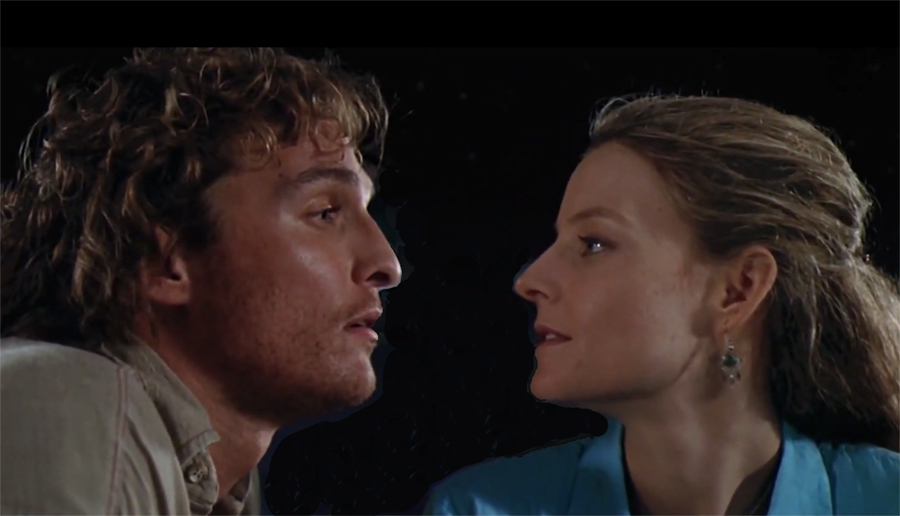 McConaughey: Unknowingly, repeating what Jodi’s (long deceased) father had said to her as a child replied; “well if there isn’t, it would be an awful waste of space.” Bingo. McConaughey had inserted himself into that special, all-important, father-daughter relationship in the best of ways. His words initiated an instantaneous response, drawing Jodi closer, her eyes fixed on his adoringly. The audience prepared itself for the intimacy that was sure to follow. There was not so much as a kiss. Science and religion, I guess.
We of course know from reading my August 2024 blog post titled “Speeding Through the Universe-Part 2”, that there are probably 2 trillion galaxies in the universe (double the 1997 estimates) with a total planet count of perhaps 1 septillion, exponentially expanding the odds that there is life out there somewhere. But what if there isn’t? C’mon TJ, why would you even say such a thing? Everyone knows there is. There has to be. I admit that is what I have always assumed. Let’s settle this once and for all. Looking at the science and the evidence.
The way I see it there are two criteria by which to asses whether there is life out there, beyond earth. Two questions I took the liberty of answering as well.
Question #1- Communications
Have we been contacted by intelligent life from another planet and/or have we successfully contacted others living on another world?
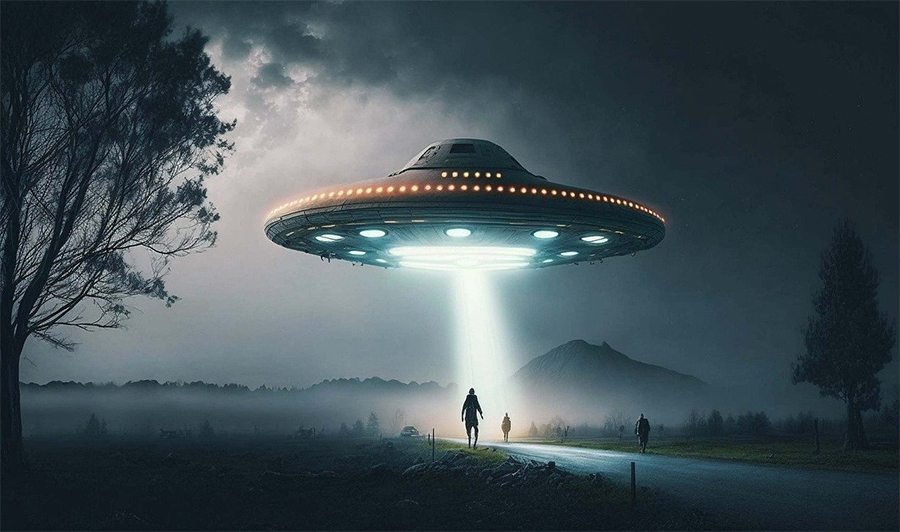 The Short Answer: You mean UFO’s, right? That term is so 60’s. Anyone in the know uses UAP (Unidentified Aerial/Anomalous Phenomena). Sounds snappier don’t you think? Also more accurate as it rules out manmade/earthly objects. Either way…they don’t exist. Merely age-old conspiracy theories that pop up every now and then to get us all riled up. Please. Why would Aliens travel, multi-generationally from God knows where, arrive at their destination, then hide? Alien hide and (go) seek? Or whoopy hide (hide & whoop) if you’re from Appalachia. Right JD?
Regarding Interstellar Travel
Based upon my calculations and given the existing laws of physics and all credible scientific study, Interstellar travel, or journeying to other planets, that could possibly sustain life will never happen. Here’s why:
Those pesky distances again: The universe is “cruelly” spread out. The distances between everything out there is unimaginably vast. The time required to travel to any of the planets ridiculously long. The speed at which we can travel to them is governed by the laws of physics. It sets the maximum speed limit for everything in the universe at light speed or the speed of light. [Light travels at 186,000 miles per second and covers 5.8 trillion miles in 1 year] Only massless things can travel at the speed of light. These include: photons, radio waves, microwaves, x-rays and others. NOTHING WITH MASS CAN TRAVEL AT THE SPEED OF LIGHT. Humans, our spacecraft and whatever else we want to drag with us can never travel at the speed of light. Never say never TJ. Yeah, yeah. Won’t happen.
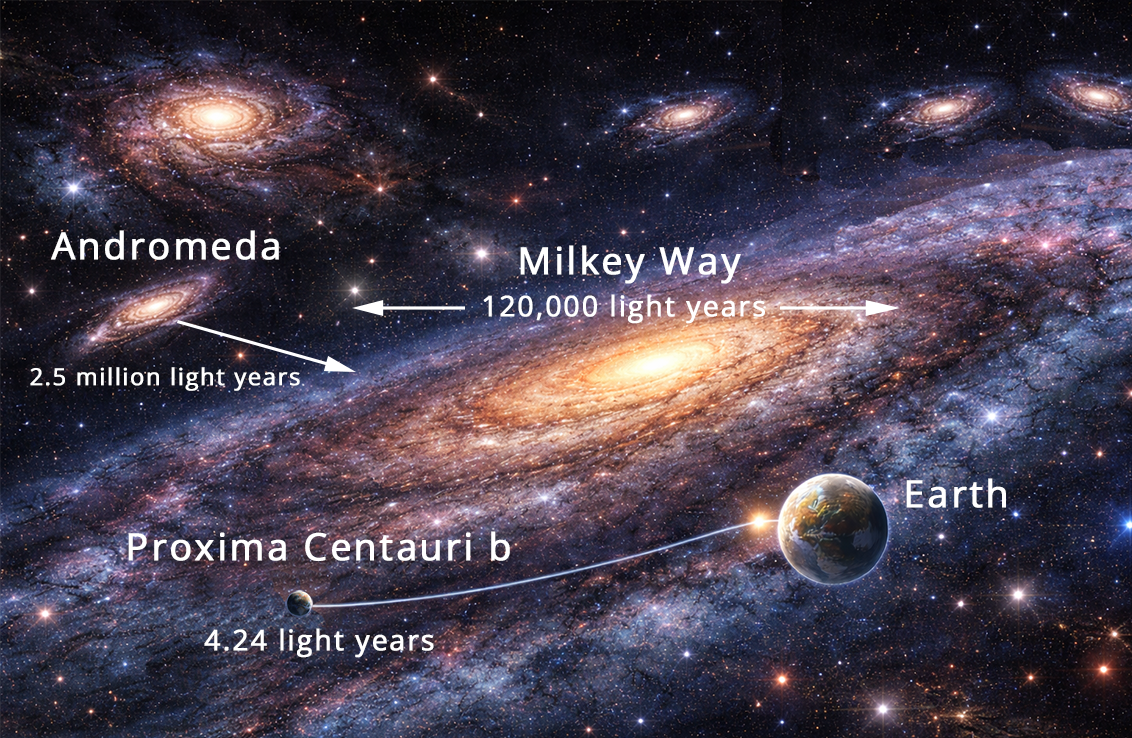 The current fastest travel speed for spacecraft is approximately 38,000 mph. Often referred to as Voyager Class in honor of Voyager 1 and Voyager 2. There are several theoretical models on the table from the “plausible”- nuclear propulsion (including fusion) that could potentially achieve 5-10% of light speed, to the “unlikely”- anti-matter or laser propulsion claiming up to 30% + of light speed. Here is what they look like, traveling to Proxima Centauri, (mentioned earlier) the nearest star to earth other than our own sun, It has 3 planets, one Proxima Centauri b is about the size of earth. It is 4.24 light years away.
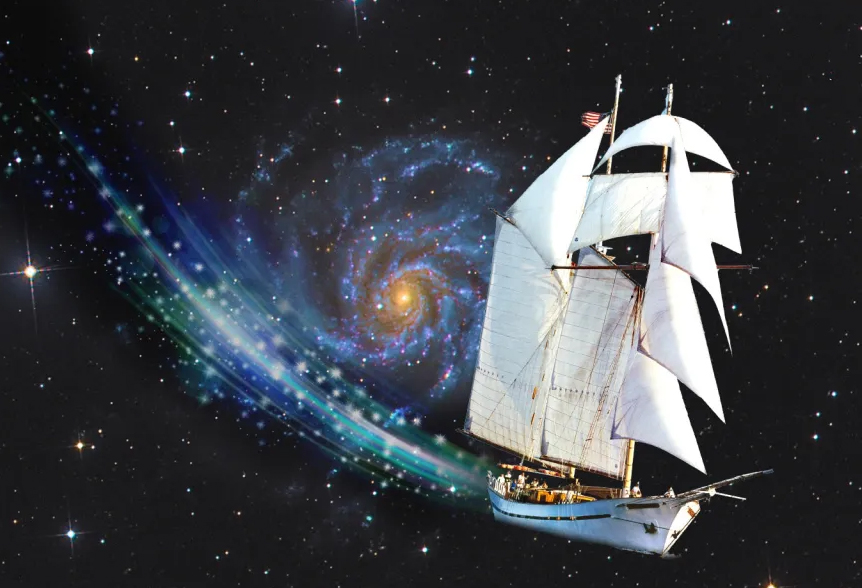
Traveling at the fastest speed possible given current technology (chemical propulsion), it will take 75,000 years to reach Proxima Centauri b. Hmmm. Advanced nuclear propulsion can cut that to around 20,000 years. For the ever hopeful out there, take heart. If we are lucky and can make nuclear fusion work, we might be able to achieve 10% of light speed, (considered the absolute upper realistic limit for human travel.) and get there in a mere 40-80 years depending upon the level of technological breakthroughs. Did I mention those are one-way times? I realize many among us are willing to cast aside logic and reason, thereby making anything possible. Humans are good at adopting magical thinking. Things like “wormholes” and “warp-speed” that defy reality but get us to where we are entitled to go. Klingon to visit Dr. Spock or Pandora to mine unobtanium.






As you probe what I term the “intergalactic vortex,” what has prompted this particular galactic one? There are so many other voticeeeeees!
I will acknowledge it beats the hell out of politics, but how about philosophy? You know, metaphysics, epistemology, morality, and yes, if we get that far, politics
I look forward to the next gathering to discuss the usual subjects by the usual suspects!
Thanks for chimming in Dave. Your right. THere is so much to discuss and so little time.
Paul
Paul-
i loved this. I have done similar ruminations and research. Significance and meaning are big drivers of the human experience. We also abhor singular and collective loneliness. All this from knowing w will all die and extinction is in inevitable.
(Think the 60 million year old comet strike that wiped out the previously preeminent species)
it’s hard to take in all that you so correctly describe. Hence God, Aliens and “Warp Factor 10’s”)
Thanks for this Paul!
PL
Well Hello Peter,
Thank you. I am glad to know there are others like me out there in the universe.
Paul