
Not in the genteel yes ma’am, no sir, bless your heart, sweet as molasses kind of way. Nor does it resemble the relaxed home cooked family meals on the porch complete with fried chicken, sweet potato pie and, of course, grits. Stop imagining the sound of horse hooves on cobblestone streets, distant church bells, cicadas in the magnolia trees dripping in Spanish moss. The smell of jasmine in the air. It’s not that South.
I’m talking about the other South. The one associated with slavery, secession, the Confederacy, and the Civil War. That South, shaped in part by bigotry and racism that is not actually geographically constrained. It exists everywhere. I use the word “South” metaphorically to encapsulate the worst of humanity. A stereotype I have not been able to shake and is at the core of what I call “migrating bigotry” – The same or similar bigoted attitudes that once defined the South have expanded and “pivoted.” No longer limited to race, the animosity, anger, and hate once reserved for Black Americans has been expanded to include a much wider variety of targets: Illegal immigrants, refugees, urban protesters, “woke” mobs, and of course the entire L.G.B.T.Q community. I nearly forgot Muslims and Jews. Sorry.
Discriminating against them now has the full backing of our federal government. In many cases, they are the ones initiating action. We’ve seen it on the streets of Minneapolis, the halls of Congress, in nearly every department within the executive branch of government. The dehumanizing metaphors emanating from the DHS are unprecedented. Terms like invasion, infestation, militarized border encounters, detention camps. Whoa, hold on, slow down TJ. We can take a deeper look at today’s craziness later. First, let’s review how we got here. Nothing happens in a vacuum. I begin with the aftermath of the Civil War.
Racial attitudes toward Black Americans did not end with the South’s crushing defeat. Although now illegal, slavery’s deeply seated underpinnings remained strong. Blacks were inherently inferior, slavery their natural condition. Immediately following the Civil War, Reconstruction (1865-1877) focused on rebuilding the South’s physical infrastructure, reintegrating the Confederate states, and providing legal protections for 4 million former slaves. The 13th, 14th, and 15th Amendments abolished slavery, granted citizenship, equal protection under the law and the right to vote. Many Blacks did vote, ran for and were elected to state legislatures and even Congress.
Political power, however, remained in white hands protected in part through legal segregation, voting restrictions, election coercion, and the like. Driven by anger over defeat, animosity toward their new citizenry and plain old hate. Racial equality was never on the table. Shackles and chains gave way to violence and terror despite the presence of the Northern Army.
White resistance stiffened when Union Troops pulled out of the South and Reconstruction ended in 1877. Southern Democrats known as “Redeemers”, how wholesome, regained control of state governments, and most of the reforms instituted during Reconstruction were reversed. Gone were federal protections reinforced in part by the military’s presence, leading to the rise of the Ku Klux Klan (KKK), the White League and other white supremacist paramilitaries. Essentially, these were arms of the Democratic Party. Violence against both Black citizens and elected officials intensified. They threatened, assaulted, and killed Black voters, Republican leaders, and supporters. They disrupted political meetings and blocked Black citizens from casting ballots. In some cases, they attacked entire Black communities. Lynchings were not uncommon.
Between the 1890’s and early 1900’s, Southern states passed Segregation Laws (aka Jim Crow) designed to separate black and white citizens in nearly every area of public life. They re-wrote State Constitutions, implemented poll taxes, literacy tests, and other restrictions effectively lowering Black voter turnout…to zero.
Economic Turmoil
Poor, uneducated and discriminated against, the economic plight of Southern Blacks was a serious issue. Not without heart (yeah right), and sensing an opportunity to make a lot of money, southern land owners, business executives, and industry leaders extended a “helping hand.” Essentially reintroducing medieval Serfdom, racially structured, under the more egalitarian title- Sharecropping. What’s not to like about sharing? Well, a lot.
Sharecropping had profound and lasting effects on Black Americans in the South. It locked many Black families into cycles of chronic debt, poverty, and economic dependence. Because landowners-controlled credit, supplies, and crop sales, sharecroppers often ended each year owing money, making it difficult or impossible to accumulate savings, purchase land, or move elsewhere. This limited upward mobility and reinforced white landownership and political dominance. Over generations, sharecropping helped entrench racial inequality by preventing wealth accumulation, weakening political power, and delaying economic independence well into the twentieth century. By 1900, a majority (75%) of Black farmers in the Deep South were sharecroppers or tenant farmers. It was often the only option available to them.
Similar “systems” emerged across many other industries including: mining, timber, textiles, maritime and fishing…you name it. Owners controlled most or all the money. Often living in company housing, rent was deducted from wages. Frequently paid in “script,” good only in the company store. Debt accumulated. Most were no better off than sharecroppers…essentially existing in economic captivity.
Meanwhile in the North
Let’s not delude ourselves into believing the South had a lock on bigotry. Everyone in the North, Mid-West and West were not high-minded egalitarians. No, bigotry in various forms has always been a part of the American experience. It is not limited to race. Leading up to the 20th Century most regions outside the South were fairly homogenous. Black populations were relatively small, concentrated in large Northern cities. Large-scale immigration from European countries was just getting started. Things changed.
-Black Migration
Two great migrations of Black Americans from the South-Northward dramatically altered the racial compositions of many urban areas. The First Great Migration (1910-1930) brought 1.6 million, more than doubling the existing northern Black population in 20 years. Cities like Chicago, Detroit, New York City and Philadelphia saw their Black populations increase 200-600%. That changed politics, labor markets, and urban culture dramatically. The second Great Migration (1940–1970) saw approximately 5 million Black Americans move northward and westward. Leaving around 53% of the total Black population in the South. For the first time since slavery, nearly half of Black Americans lived outside the South. Nationally, Black Americans remained around 10–11% of total population through much of the 20th century. I believe today that figure is closer to 13%. So, the migrations did not dramatically change the national percentage. What they changed was regional concentration. As we all know “shift happens.” Beginning around 1970, 4.5 million Black Americans moved to the South from other states. A “Reverse Migration” effectively neutralizing earlier migrations.
“On the boats and on the planes…their coming to America.”
While living in Ireland and England for a year I would frequently listen to Neil Diamond’s- America, while working out. It was brand new at the time (1980), inspired by his grandparent’s journey from Eastern Europe to NYC, and it gave me goose bumps every time. Today, it’s tears.
-Immigration to the USA
Immigration to the United States is of course ongoing and constant. It is however, worth noting 4 major eras when large numbers of immigrants entered our country:
* Colonial Era (1607-1775)- Roughly 600,000–800,000 Europeans arrived before the Revolution. That sounds small — but the population base was tiny. By 1775 our population was about 2.5 million. 20% of which were enslaved Africans. Interestingly, approximately 5 million Natives occupied the same area along the east coast.
* Early 19th Century Wave (1820–1860)- About 5 million immigrants arrived between 1820–1860. Among them many Irish escaping the Potato Famine. By 1860 our population reached 31 million, 13% of which were foreign born.
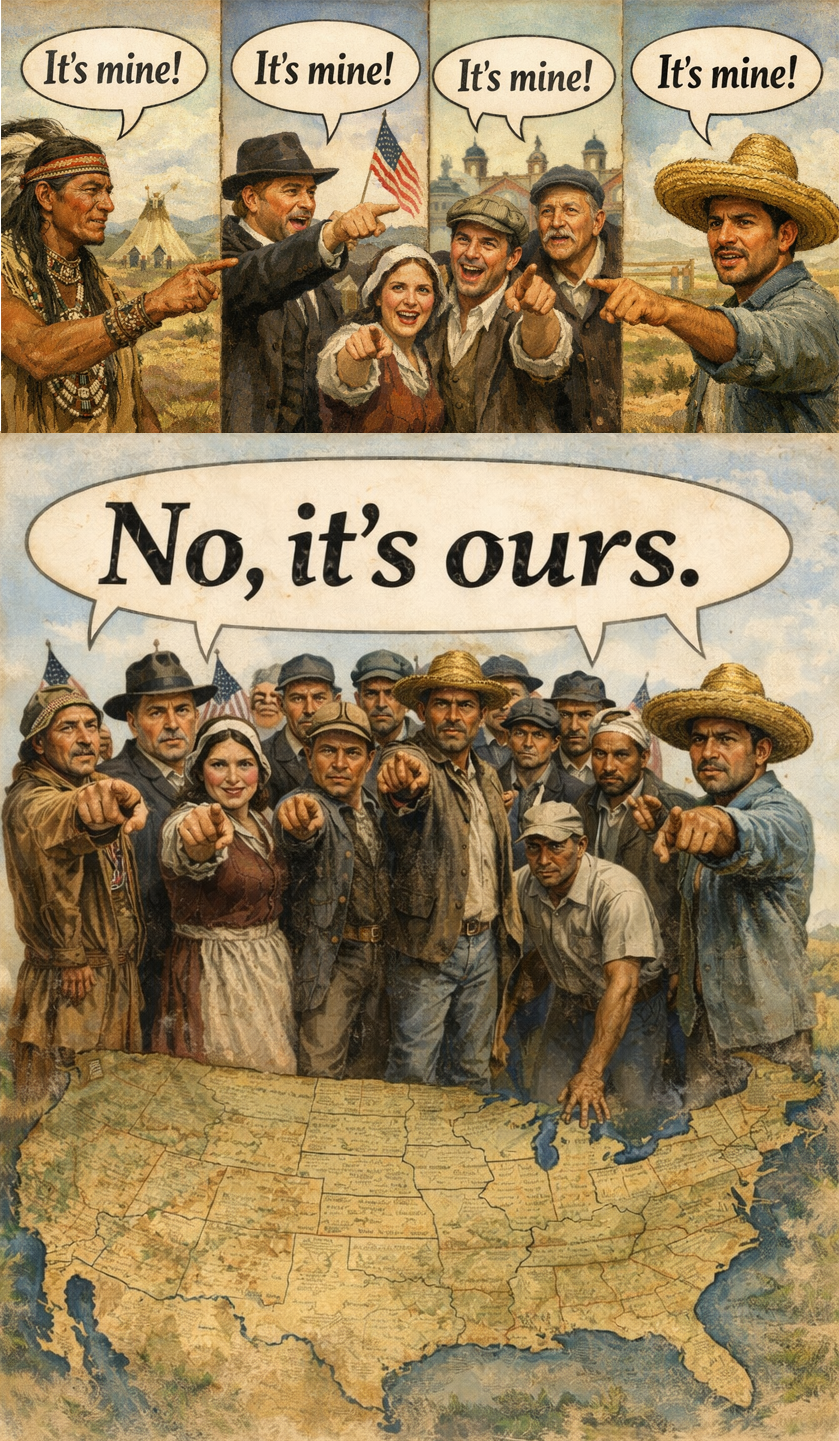 * The “New Immigration” Era (1880–1924)- Between 1880 and 1924 alone, over 23 million immigrants entered the United States. The overwhelming majority were European- German, Irish, Italian, Polish, Scandinavian, and Eastern European Jews. Mainly to large cities including: New York, Chicago, Detroit, Cleveland, and Philadelphia. Approximately 95% settled in the North and Midwest. Odds are, among them were our grandparents, possibly even our parents. They were not always welcomed with open arms.
* Modern Immigration Era (1965–Present)- The Immigration and Nationality Act of 1965 ended national-origin quotas, shifted immigration toward family reunification and increased immigration from Latin America and Asia. Immigration increased steadily after 1965, accelerating since 1980 when only 6% of us were foreign born. Since then, we have increased our national population by 50% from 226 million in 1980 to roughly 342 million today. Our foreign-born population is at 15%, with the highest number of immigrants ever. Please note that the figures I put forth are inclusive of the estimated numbers of undocumented/unauthorized immigrants, aka illegals…13 million.
RACE
As a nation America has had a “complicated” relationship with race. Beginning with the African slave trade that fueled the South’s economy right through to today. As moral, legal, and social boundaries shifted, and the civil rights movement took hold, racial bigotry adopted new techniques. More subtle, almost respectable at least to them. The same racial bigotry adapted to new forms. Perhaps more subtle, democratic, or respectable, but no less damaging.
During my childhood, the nineteen fifties and sixties, overt racism became harder to defend. Bigotry mutated, taking on softer forms like *Redlining and a quest for law and order. Race need not even be mentioned. Instead, the focus shifted to crime, culture, neighborhoods, and values. Bring on the War on Drugs, mandatory minimum sentences, three strike laws, stop and frisk, and militarized policing. In short, the new Jim Crow. Blackness was increasingly equated with criminality. Violence referenced in the name of public safety. The public for the most part supported get tough on crime initiatives even if those most impacted by strict penalties were poor and urban minorities. Crime rates were high and public fear was widespread.
*Redlining, the practice of denying financial services, like mortgages and insurance to residents of specific, often minority-heavy neighborhoods, actually began during the Great Depression.
Race & Immigration appear to be at the core of much of America’s dance with the worst part of human nature…bigotry and our capacity to hate. Why?
…everyone needs a bogeyman
As it turns out, most of us are averse to change, especially sudden change. Socially, economically, culturally, and politically, we prefer a comfortable level of predictability. When confronted with new ideas, technology, or unfamiliar faces, we become suspicious, protective of our own ways, often digging in our heels when forced to adapt to change even at the risk of social isolation. Change is hard, potentially destructive, and of course inevitable, the one constant. Regardless, assimilating millions of immigrants into the American way of life took decades and was far from smooth.
Confronting our biases and prejudices is always challenging. Keeping them in check is essential work in any civilized society. When unable or unwilling to put them aside, our thoughts and behaviors can escalate to the level of bigotry and racism. I like to separate each level as there are important differences. Doing so also allows for a healthy discourse concerning race and racial differences. This is why I suggest we……
Bring Back Bias & Prejudice
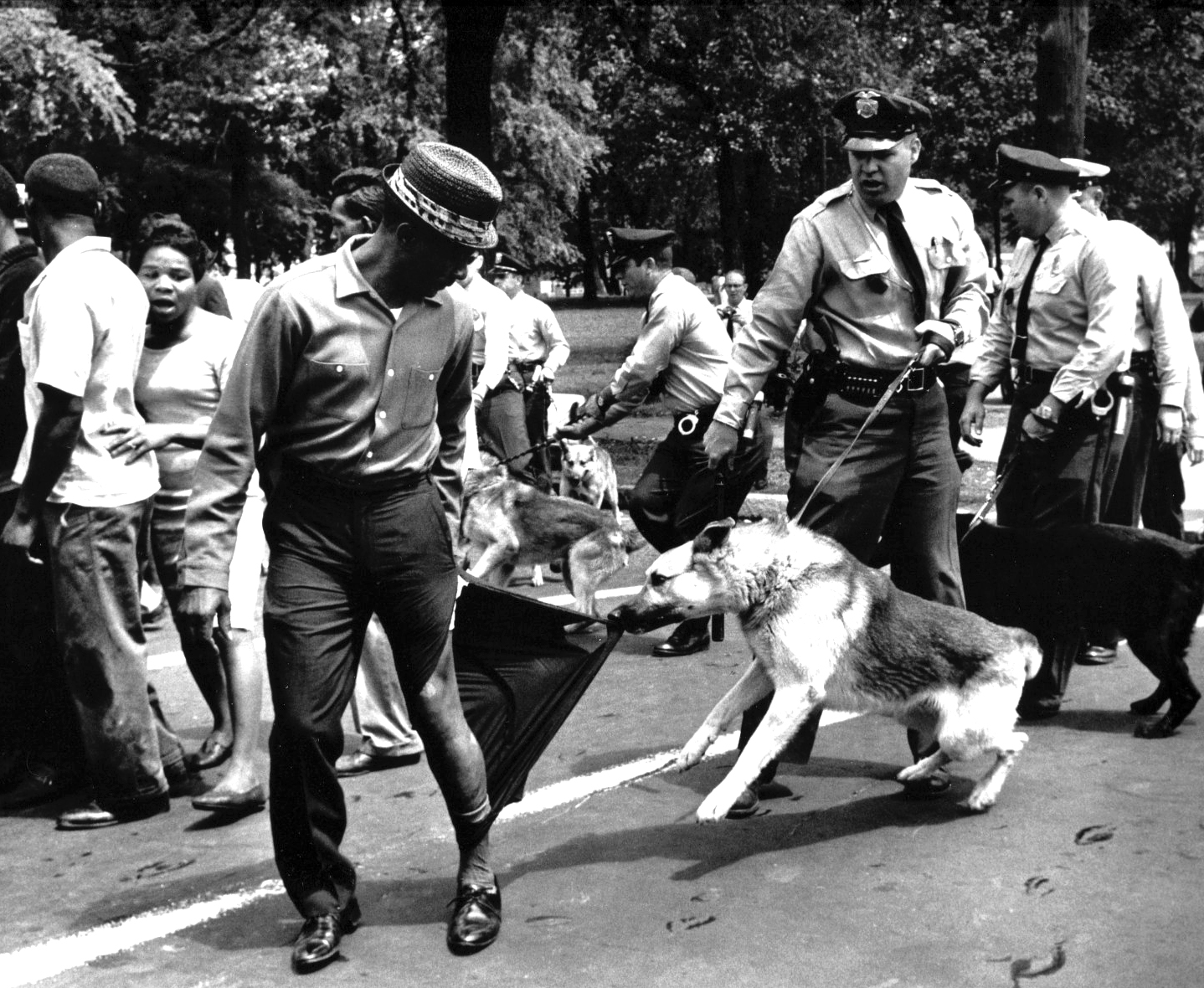 Wait a minute. What? I mean the terms. Growing up in the 1950’s and 60’s afforded me a front row seat at yet another crossroads in race relations in America. Certainly not the first and probably not the last time we confront or are forced to confront our demons. The civil rights movement was in full swing. I was a sophomore in high school when the 1965 Voting Rights Act was passed into law. A lot was going on and much of it was far from peaceful. All across America demonstrations, discussions, debates, and protests were taking place. In the halls of Congress, on the streets, and at our dining room tables. Walter Cronkite would remind us each and every evening: “that’s the way it is.” Unless you, or more likely your parents, preferred listening to Chet Huntley and David Brinkley on NBC.
Opinions about anything related to race, race relations, our history of slavery, etc. were out in the open and freely discussed. Although tempers were often heated, it seemed possible to actually discuss events of the day without destroying our relationship with friends, family, or the community. Even when we strongly disagreed with others, we respected their right to express their opinions. I believe this was because we differentiated between bias, prejudice, and racism.
All humans have biases. We are genetically hardwired to categorize other individuals, groups, and situations. Unconsciously, we prefer or are more comfortable with others that resemble our family, are close in age, share our accent or belong to the same club. Sounds like the “birds of a feather” cliché. Well, it is, and there is nothing inherently wrong with it. However, once we attach negative meaning or attributes to “others” outside our group, generalize or make assumptions or pre-judge, our simple biases can become Prejudice. Even if subtle or socially normalized (ex. Teen age boys are lazy or Asian students are smarter than…) it could become problematic.
Then there was Racism. The worst of the worst. Morally corrupt. Villains. Extremists. Believing someone was racist or calling someone out for it was rare. Perhaps we were naïve or overlooked things we shouldn’t have. Or perhaps living in a small rural community without a single Black family or individual had something to do with it. But to me at least, racism was reserved for the likes of those with a KKK mentality. Racists believed in the superiority of one race over another, usually the white one, and behaved accordingly. I prefer my gradations to today’s more academic use of the word racist. Not because I need wiggle room but rather to actually engage in conversations about race that last more than 30 seconds. Sensitivity levels among younger generations seem a bit extreme at times and unforgiving. No, I am not a racist for using the term Black instead of African-American. The focus on structural or institutional racism today, something beyond my radar for most of my life further, complicates matters. At the end of the day, as part of the “national dialog” everyone claims they want to have, patience, understanding and an open mind are required. Without these, we instead get…a shouting match.
Historic Change
I already mentioned how humans prefer the status quo, often viewing strangers as a threat rather than as a friend. Those that do not look like us, talk “funny,” and suddenly live next door, or are now the majority population in our children’s school. Often viewed as an invasion. Forcing many to fight back, to flee, or to adapt to change.
Everyone alive today has witnessed changes of epic proportions. Their scope is unprecedented. While adjusting to changes in the makeup of our population, we have navigated revolutions in technology, medicine, industry, and communications. Much of what was, is either no more or in some state of evolution. In addition, we’ve experienced significant social, cultural, and economic change over the past few decades: evolving social norms have brought to the fore: LGBTQ rights and gender awareness, mental health openness, personal boundaries, to name a few. Changing family dynamics have been challenging for many: delayed marriage and child rearing, single parent households, cohabitating couples, and stay-at-home fathers.
As with all change, some fare better than others. Men generally do not adapt to change as readily as women. Perhaps in part because of their mistreatment by men, having to adapt in order to survive, over the course of a few hundred thousand years.
American men and boys, as we know, have been hit particularly hard. Traditionally secure jobs in many industries have vanished. Wages stagnated and education began rewarding different skills. Many men didn’t just lose status; they lost the script for how to be a man.
Add to this the rise of women in all phases of once male-dominated enclaves- the business world, education, tech. The Me-Too movement, stigmatizing bad male behavior. Men’s place in society and their role is now unclear. I dare not mention AI in the role it will play in further eroding their self-worth. As it is, many men feel they are becoming dinosaurs in a world they helped build, dominated, controlled, and greatly benefitted. White men anyway. Young men and boys are just as confused, even as they avoid their changing world by playing video games in the basement. Something is wrong. The signs are clear:
– Boys underperform girls in school at nearly every level.
– Men are less likely to graduate from college.
– More men dropping out of the workforce entirely.
– Men have higher rates of suicide, addiction, incarceration.
– Also, fewer close friendships, and experience more isolation.
Most, if not all, of the disruptive changes we are witnessing are beyond our control. How we react is another matter. When people feel powerless, they look for someone to blame. TA DAH!
Enter Donald Trump & MAGA
Trump built an entire political organization around displaced, angry men and disgruntled women, essentially co-opting the Republican Party. Their message was simple, clear, and timely-
Fear often turns into bigotry and cruelty. Bigotry isn’t born from strength; it’s born from status anxiety. So when:
| Some men respond by:→ |
|
Cruelty becomes a way to feel solid again.
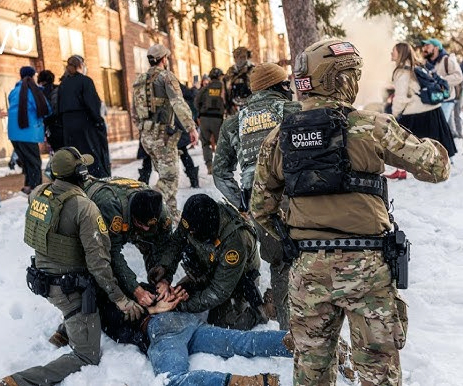
Many (half the nation) apparently had enough in 2024, so threatened, so angry, so seemingly displaced, and without power, they were willing to put Donald Trump in the White House and embrace the MAGA agenda. Remaking our system of government, installing like-minded bigots into every branch and department, willing to disregard our system of laws. Willing to tolerate criminal behavior. Supporting armed goons in Minnesota. Enough, you get the picture. You live it every day.
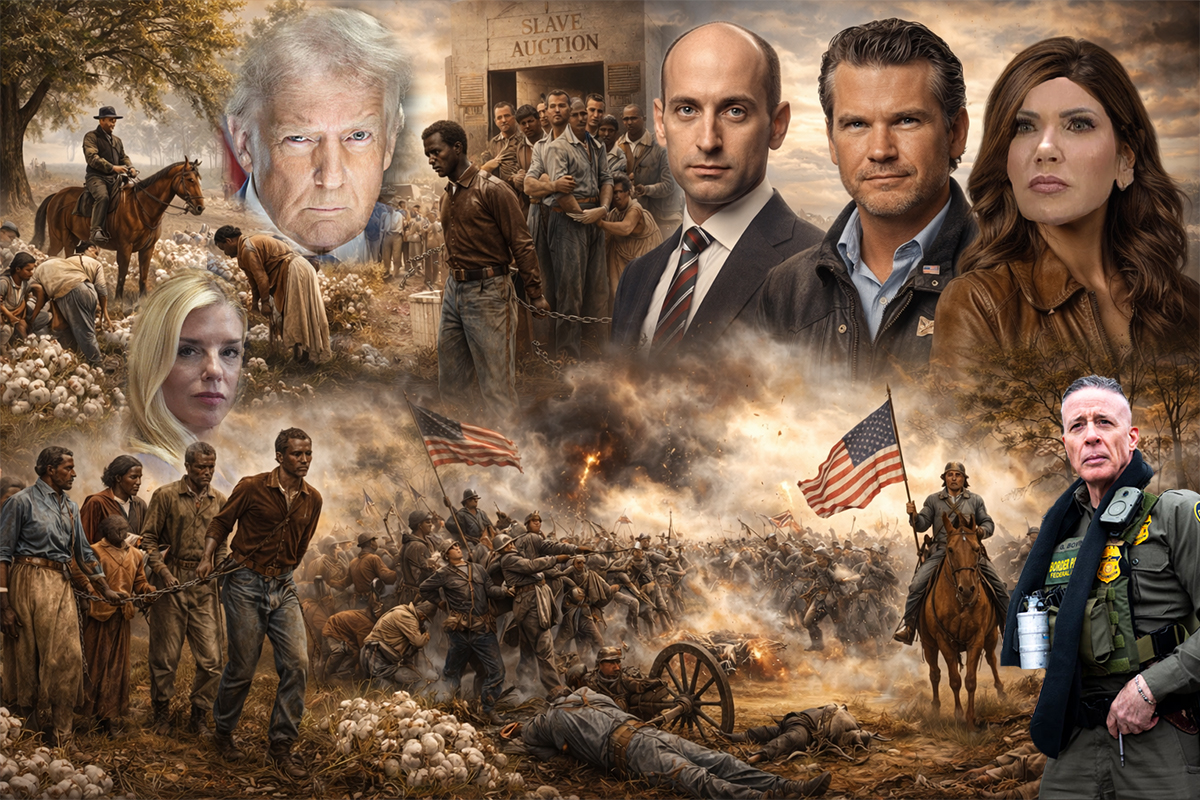
Given the designed chaos surrounding our current government, sustained focus has been elusive for me. So let me wrap this up. First by clearly stating that: “The behavior of President Trump, many in his cabinet, and others in the various departments that support this administration’s agenda, is reminiscent of the American South during the Civil War.” By default, I would add all the members of Congress that have demonstrated their support either actively or by remaining silent. Abdicating their constitutional responsibilities.
I conclude by sharing my thoughts relative to:
 Fixing Our Immigration System
We (America) are not who we are in spite of immigration, but because of it. For most of U.S. history, there was no modern immigration system. No defining legal or illegal. Millions of people came to America as pioneers, settlers, adventurers, homesteaders. These were our ancestors looking for opportunity or a better way of life, freedom, democracy, or simply getting a fresh start. Celebrated today as the backbone of our nation. Until the early twentieth century our borders were porous, documentation minimal, and enforcement often nonexistent. Now attempts are being made to categorize these “adventurers” as criminals. The thirteen million or so here “illegally” are the same kind of people that have always come to our shores. Despite the lies and fear mongering put forth, the overwhelming majority of immigrants legal and illegal are the same dreamers as our grandparents and the many millions that have made their way to our shore’s hopeful for a better life.
Most agree that our immigration system needs fixing. But there is a right way and a wrong way to go about it. Our government has chosen the latter. As evidenced by the cruelty, inhumane treatment, and illegal tactics employed by the Department of Homeland Security (DHS), U.S. Customs and Border Patrol (CBT) and of course the U.S. Immigration and Customs Enforcement (ICE). Mass deportations, especially the way they are being conducted, is not the way forward in reforming immigration.
This is not who we are. This is not how America, the beacon of hope around the world, behaves. This is not how leaders, our federal government, and politicians should behave. They should all be ashamed. What do they tell their children? These are not good people. Trading their humanity for power and money.
Americans have a sense of justice, fair play, honesty, integrity. We will not allow this new South to rise up and destroy what so many have built and protected with their lives. The world is watching.
Call off the dogs.
TJ