

Hello,
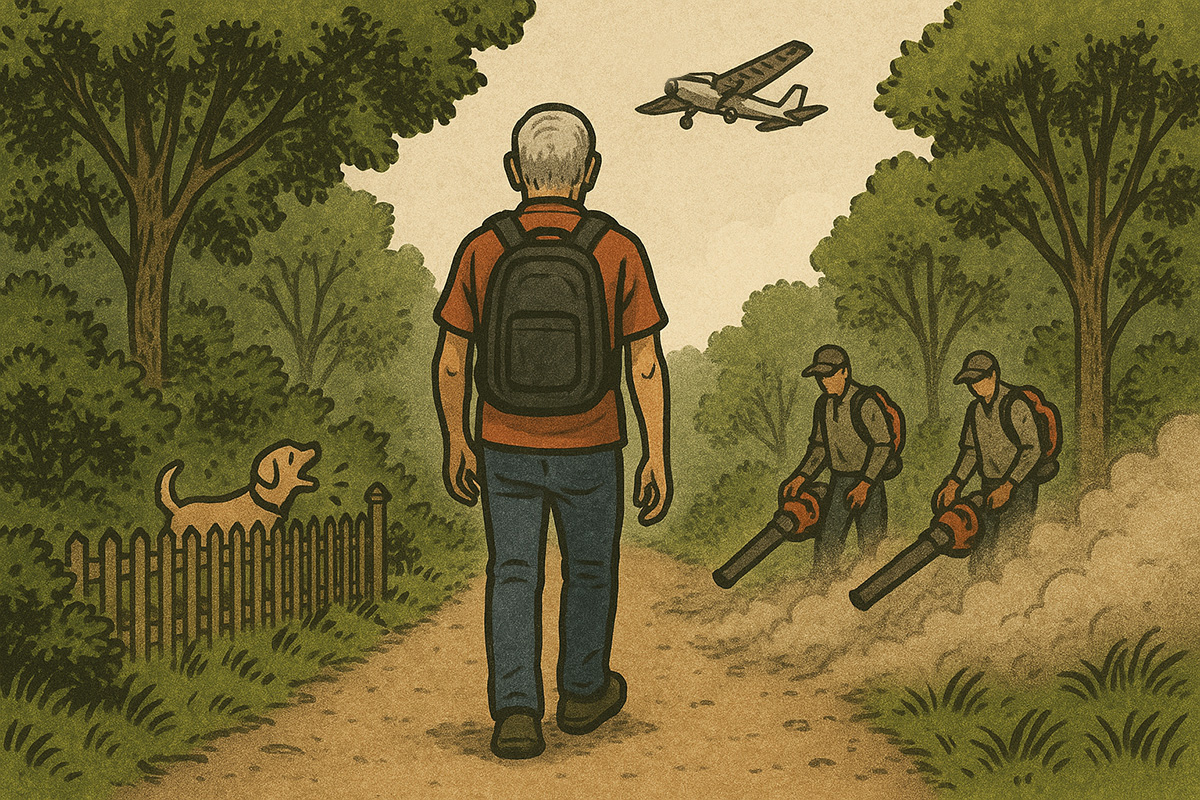
I set out this morning for a short, brisk walk to get my “blood flowing.” As opposed to letting it pool around my ankles, I guess. By Colorado standards this would require a 20k sprint at an 8mph pace. I settled on a reduced threshold. My orders were clear; go out and experience nature. Listen to it. Feel it. Be one with it. Tune out all the distractions. Be Zen like. Ahh. Sounds perfect.
It was 42 degrees and overcast but my head was in the right place. I heard a few birds nearby. A fox darted out ahead and three squadrons of geese traversed the sky in the distance. In total control of the heavens. Nice. It doesn’t get any better than this. I spotted a dog in a yard bordering the path. A beautiful golden retrieverrrrr. Oops I must have startled him. Woof, woof, woof. But just until I was out of site. Quiet again. No one else around. WRRRR, overhead. A low flying piper cub. We are less than 10 miles from a small airport after all. Share the space, right? We are all one. He’s gone now. Out of sight, out of mind.
Suddenly, my least favorite “thing” blew up my walk. The sound of 2 or 3 gas powered leaf blowers doing their thing in an adjacent apartment complex. All the leaves are down now and this is probably the last go around to remove all traces of autumn. Making room for the winter’s snow. I get it. Now what? The environment has changed and I am not yet skilled enough at tuning things out or changing my mood on short notice. Somewhat disconcerting considering I’m no spring chicken. More like a dead duck at times.
Transitioning from “the Zen” came quickly and I began to think about the leaf blowers which led me to another pet peeve and another. So, here are a few of the things that bother me to varying degrees at various times. No, I am not an unhappy person nor do I carry grudges. It’s simply a few things I have noticed over the years that struck some inner chord. Usually they make me laugh even if to me they may be silly, perhaps absurd. Let me know if you agree or disagree with any of them. Feel free to submit some of your own.
SPEEKADAH INGLISH!
I am not a linguist so I am not versed in the finer studies of the English language. My skills do not include analyzing the syntax, semantics, morphology, phonetics or phonology of our language and its proper use; not synchronically, diachronically, certainly not mono, or multilingually. I am also not a literary expert. I just know what sounds…wrong. Here are a few of my pet peeves, related to the English language
Without doubt the most abused, misused, and overused, word of the 21st Century. It appears I am to blame. I spotted the trend several years ago. I thought about bringing it to the world’s attention, then covid hit. I neglected to speak up and it only got worse. My apologies.
Nearly everyone is littering their sentences with the word “literally.” It began mostly among teenagers and young adults. Their parents picked it up and it spread like wildfire throughout all generations of Americans. No one is immune. Professional journalists, podcasters, even social media influencers for crying out loud, have elevated this simple adverb to the point of absurdity. I’ve heard it used three times in a single sentence. Never properly…always superfluous. Aargh. I’m sure you come across this phenomenon every day. It’s hard not to notice. Once aware, it’s even harder not to start counting. It’s the new “like.” Like ya know what I’m sayin. Like yeah. Like wow.
There are ways to insert the word “literally” into one’s statement correctly. For example, when attempting to prevent a misunderstanding or to ensure the speaker is not “exaggerating.” Ex. He literally ate 20 pancakes. – when he actually did eat 20 pancakes. Or when something is actually true in a factual, non-figurative sense like: He literally drove 1,000 miles in two days. (He truly did.)
So, how are people using “literally” in the wrong way? Here are a few examples:
– “I literally exploded with anger.”
– “She literally melted when he smiled.”
– “I literally died laughing.”
You don’t explode, melt, or die.
– “His eyes literally popped out of his head.”
– “My brain literally stopped working.”
– “I was literally on fire during the presentation.” Unless of course you were on fire but that’s another story for another time.
– “I literally can’t even.”
– “That was literally so cool.”
– “I literally went to the store, literally bought milk, literally came home. (A triple violation.)
The experts say:
* People want to add emotional emphasis, so “literally” gets tossed in even when they’re describing figurative feelings.
* Because so many people misuse it, dictionaries added a secondary definition:
“Used for emphasis, even when not literally true.”
This makes purists furious, but dictionaries record usage — they don’t police it.
Simple rule of thumb
Only use “literally” when the statement would still be true if someone checked it with a stopwatch, a map, a thermometer, or a camera.
If the event couldn’t be photographed or measured exactly as described, “literally” is the wrong word.
Got it.
So, please stop. I’m begging you to stop misusing the word literally…literally. Literally, I am…literally.
Let’s move on.
I have lived my entire life without ever hearing the term “physicality” used in a sentence. Until recently. This term has exploded in popularity over the past few years, mostly across sports broadcasting. If you watch any sport on tv you know what I mean. Instead of “he’s strong and plays tough it’s “his physicality is amazing” or “she is relying upon her physicality to out distance her opponent.” Is this a “softer,” “gentler” way of discussing rough and tumble behavior within the sports world? Or are announcers trying to sound more “insightful” than they really are? Smarter, perhaps, or less like a jock. More professional while not really providing any real information.
Thanks to “jargon creep” you will hear the term “physicality” on the side lines of a 5-year-old soccer match. If you’re lucky while watching a basketball game you may hear the term “verticality.” Meaning of course: he went straight up. Annoying.
Unless you’re a sociologist or anthropologist, the term “religiosity” was rarely heard outside academia or theological writings. It has escaped the lab and, through the copycat effect, is popping up everywhere. Especially when journalists, commentators, authors, or podcasters are discussing things like “religious decline” among Americans or a rise in adherents to Islam.
It sounds more intelligent or analytical
Just like “physicality,” the word feels smarter.
Compare:
Even though the meaning is almost identical, the second feels academic. I get why. But sanitizing our discussions, removing the emotions feels like…cheating.
It gives people a way to avoid emotional or value-loaded terms:
“Religious” can sound personal or judgmental.
“Religiosity” sounds detached, sterile, scientific.
It lets people talk about religion without sounding like they’re making a moral claim. Hmmm. This may be a good thing. Any discussion of religion can be problematic enough as it is. So, even though it can feel like forced intelligence, pretentious, a tad unclear or faddish, I’m removing it from my list of Pet Peeves. Feel free to use it or hear it. How generous of me.
It’s almost always, unnecessary and sounds clunky. In everyday speech just saying “quote” is enough. I suppose we do so out of habit or to sound more precise, or authoritative. I find it too formal and awkward. If your worried about being sued, use “air quotes.”
Almost always we use the “quote-unquote” term when referencing stereotypes or questionable labels, not actual quotes:
He’s a quote–unquote “genius.” She has a quote–unquote “normal” family. You’re saying I don’t accept these labels or flat out reject them. A way to insert sarcasm or distance ourselves from something. A great way to point out a stereotype without endorsing it. Regardless, you still only need to say “quote”.
Then please do so but the correct expression is “I couldn’t care less.”
“In any way” covers it all. Fight the urge to sound more dramatic or emphatic or perhaps legalistic by adding the unnecessary qualifiers: “shape or form” to your statement. They are superfluous.
“Just a fraction” of the population is left-handed. Or, only a fraction of automobiles are electric. Not helpful. Anything less than 100% or greater than 0 is a fraction. Use an actual number. This term is often used to denote or insinuate a small number or percentage but always leaves me wanting to know how many.
Ending a sentence with a preposition:
Where are you going to? Or Why’d you do that for? Sounds pretty hokie doesn’t it?
“IRREGARDLESS” Yes, it’s a word found in some dictionaries. Don’t use it. Drop the IR for the same reason you should not end a sentence with a preposition and avoid that quizzical look.
“Over-Exaggeration” is redundant. “Exaggeration” already means going beyond the truth. You can’t “over-exaggerate” — that’s like saying “over-overstate.”
“Horse Back Riding”…is there another part of the horse you can ride?
“BC” & “CE”– Before Common Era and Common Era respectively. Hate ‘em. Even if they are now the default terms for Before Christ (BS) and After the Death of Christ (anno domino-AD) in nearly all academic disciplines both in the American and European Universities. This has been true for many years but has only recently leaked into mainstream society through media outlets. Anxious to establish religious neutrality. I understand. It’s not a big deal but does seem a bit PC-ish. Interestingly, the dividing line between the two is still the same. So, feel free to continue using BC and AD along with most of the western world including me.
Perhaps because we have been watching a lot of PBS (Masterpiece Theater) shows like Call the Midwife and All Creatures Great and Small, I have grown accustomed to G or PG language. Frankly, I am appalled by the casual use of the F-word pretty much everywhere. F-this. F-that. It’s become quite fashionable, uttered without thought and usually unnecessarily. Does it really enhance an idea, a stance or emotion? Perhaps at times, but not all the time. Swearing, or cussing if you prefer, can help reduce stress when angry or in danger. But it always had its place along with its limits in civil society. Imagine what your mother would say uttering the F-word to her when you were a child.
I’m nearly convinced that movie directors and producers have done studies that demonstrate a correlation between audience size and the number of times the F-word is used. Use it constantly as the lead actress Mikey Madison did the 2024 comedy/drama ANORA and you win the Academy Award for best actress.
C-Word– I even had to gray this word out because for me it is without doubt the most offensive word in the English language. I cannot get myself to say it even silently to myself. I heard it once when I was probably 10 years old and for some reason I was horrified. Until last year I had not heard it used even once, anywhere. For whatever misguided reason, British and American film makes have decided to sprinkle the C-Word around their productions. I cringe each and every time. Why audiences, especially women, have not taken a position against this most misogynistic of words is baffling.
“Settled Science”

A lot of people these days appear to be junior scientists. Or at least all in on adding credibility and heft to their arguments. Using terms like: “the science tells us,” “the research shows” or “follow the data.” Data is neutral to be sure but it leads to the creation of statistics. We all know what follows, “there are lies, damnable lies and then there’s____________.”
Data driven arguments are not limited to any one science, like climate change, but extend to other disciplines like psychology, medicine, or astro-physics. Science and its pursuit is a good thing. But it is a method, not a final answer. Science must always be open to new evidence. Even when that evidence turns existing theory on its head.
Ergo science is never settled. Keep an open mind. Proceed with caution. Don’t go all in, all at once on anything. Certainly, do not use the term “settled science” to end a discussion and the possibilities that may come from maintaining an open mind.
“G.O.A.T”– There is no such thing as the Greatest of All Times in any field, sport, or human endeavor. It’s a marketing tool used to stir things up, debate, generate excitement and, mostly, make money. Unfortunately, much of younger generation buys into it and mis-applies it beyond sports to their personal lives. Their identity, success, even friendships are impacted. GOAT culture gives kids an oversimplified, hyper-comparative way of thinking about greatness. It teaches them to obsess over “best ever” instead of appreciating hard work and excellence in a realistic context. Does this make me an old goat?

Here are a few Politically motivated changes to commonly used terms: | ||
| Then | Now | Reason for adoption |
| Illegal Immigrant | Undocumented/Unauthorized Immigrant | Reduces stigma |
| Disabled Person | Person with a disability | Part of the “person-first language” movement. |
| Drug addict | “Person with substance use disorder” | treat addiction as a health issue, not a moral failure. |
| Prostitution | Sex Worker | To reduce stigma and emphasize labor conditions rather than judgment. |
| Trans Sexual | Trans Gender | “Transsexual” came to be seen as outdated or clinical. |
| Indian (USA) | Native American, Indigenous, Native people | Evolving preference among tribal communities; Driven by Tribal councils, universities, UN, media. |
| Slaves | Enslaved people | To emphasize that slavery was something done to people, not their identity. |
| Global Warming | Climate change/crisis | “Global warming” was too narrow; “climate crisis” emphasizes urgency. |
| Ghetto | Under resourced community | To avoid negative or racially loaded connotations. |
| *Stewardess | Flight attendant | “Stewardess” was strongly associated with women only, especially in the 50s–70s. |
*Classic Example of successful change. Universally adopted by airlines, unions, and the public at large.
Changes adopted long ago:
garbage man → sanitation worker
secretary → administrative assistant
mailman → mail carrier
fireman → firefighter
waitress → server
Almost always because:
It’s a top-down process, not organic everyday change. However, to succeed, or at least avoid failure, changes in language-terminology must also organically make their way throughout society. Now I get it.
Notable attempts at language changes that backfired: | |
LATINX a gender-neutral term for Latino and Latina. I guess no one actually asked them. Once contacted most Mexicans would prefer to be referred to as Mexicans. The same goes for other Central and South American citizens. Their identities are more closely aligned with their country, not some made up generic category. | |
BIPOX (Black, Indigenous People of Color) …Treated diverse groups as a single category. Many Black and Indigenous activists objected to being lumped together | |
BIRTHING PERSON OR PERSON THAT BIRTHS- to replace mother or woman. Unbelievable. Who thought that one up? And thought it would stick? I heard it used continuously on NPR during a segment on child birth. I thought I was on another planet. | |
Other attempts | Reason for Failure |
“Differently-abled” instead of “Disabled” | Felt patronizing and sugar-coated Made disability sound like a “gift” rather than a real challenge. |
“Justice-involved individual” instead of “Prisoner/Ex-con” | Too long and bureaucratic. Public and media found it confusing. Many reformed offenders themselves think it sounds evasive. |
“Global South” replacing “Developing Countries” | Many “Global South” countries aren’t southern (e.g., India). Implies geographic division more than economic one. Some nations reject being grouped together at all. |
General reasons for failure: Language changes fail when they are:
| |
That’s all I have. Thanks for listening.
Paul
I left my home in the small Western New York city of Batavia in March 1977 vowing never to shovel snow again. Never say never. Settling for 38 years in what was for me the "promised land" of Santa Barbara, California. I married, helped raise a family, started a business, traveled and live a wonderful life. We spent the last 10 years of our west coast journey in the small, quiet, picturesque town of Ojai. My oldest friends call me TJ.
My wife Deborah and I moved to Colorado in 2015 to be near our daughter, her husband and 2 growing grand-boys. Add 2 bulldogs (French & English) to the mix and our hands and hearts are full. We all reside in Niwot, a small quaint town 15 minutes north of Boulder. The mighty Rocky Mountains are at our doorstep.
I am a man, son, brother, cousin, friend, husband, father, uncle, grand father, in-law and mostly retired Coloradan. You can read more about me on the About Page. If you are curious about my professional life you can visit my Career at Venture Horizon.
Your information is secure and private. You can cancel at any time.
how about how annoying it is when someone does what I just did.
I spoke to words while riding my stationary bike and then sent it without rereading it. Sorry for how confusing it is. Maybe I’ll just tell you in person.
hi Paul
” totally” agree with all that you wrote. I got “tripped up” by totally.
Let me start again. I agree with all of the words and phrases about which you wrote wow I almost got caught in writing which you wrote about damn, I may put my ride into a side.
I truly (oops) enjoy all your blogs. Give me a next one you can have a few more things that bug you. Two people in one car talking on phones at the same time. Driver is still parking spaces from somebody waiting, etc..
Bob
Hi Bob,
I get it. Pretty trippy.
Paul
Just like science is never settled, language is always evolving. I appreciated your examples and one in particular really speaks to me: birthing people, or how I originally heard it, pregnant people. I think I understand the origin (having to do with trans people?) but no way should “women” be erased for the sake of a very very tiny minority. I am so relieved the attempts at this new phrasing didn’t gain traction!
Thanks Fran,
Though at times it seems like “devolving” to me. But I am willing to let the future decide.
Paul
WOW Paul,I’ve only read a couple ( possibly literally )of your posts as they only appear sporadically on my FB, but I am mightily impressed !
Hi Phil,
Good to hear from you and glad you enjoyed it. I will add your email to the list. That way you get a notice when I put out a post. Merry Christmas.
Paul
Irregardless of what the quote, unquote G.O.A.T. critic was over-exaggerating about for, the absurd physicality and verticality of the nukuler horse back riding sequence discussed in his latest blog post was so overwhelming that the fact that I literally thought my brain stop working and began to melt and die laughing before I could explode with anger proves that the controversial content, which included both the F-bomb and C-word, was only just a fraction of the problem for digestion, since the argument was presented as if it were settled science in 100 CE, making me feel I could care less about the relevance of the topic because I can’t even process it in any way, shape or form.
Buddy
Perfect. Thanks for chiming in.
Paul
Paul,
I literally, “quote unquote” enjoyed your blog. But the physicality involved was overwhelming to the point where I “could care less”
Just a bit of humor. Keep them coming.
Andy
Thanks Andy…I will.
Paul
Thank you professor! Brilliant. Literally.
You missed one that I would love to understand. WOKE. What an inarticulate word. What does it mean?? How did it get started? I hate it.
No human being is illegal.
Thanks for your time and effort. I enjoy. I would say really enjoyed but maybe that is one too many words.
Hi LaRue,
It’s always good to hear from you. Thanks for reading it and your kind words.
Paul
Good Morning, Paul, a positive and polished parsing of peeves precisely positioned to please–literally! But seriously, nice job. I have done my small part to stamp out the ubiquitous “like,” with little success. It makes a true simile blush! From Oregon to Colorado, happy holidays!
Hey Jeffrey,
Thanks for reading my Pet Peeves and for helping to keep our language alive.
Happy Holidays to you as well.
Paul
Great observation & description of theses overused / misused or inaccurate phrases. I’d like to throw one or two into the hat – ‘so fun’ and ‘Kiddos’, is it so hard to say so much fun or kids ?
Thanks Don. I suppose some people don’t want to “waste” their words in some cases while pilling on in others. Go figure.
Paul
Literally, an enjoyable read! Figuratively, really? In the “Zen” of your being, these examples bug you? Literally? Figuratively”
Alas, I am “largely” in agreement with you!